
Heavy project loads / Equipment in use
750t Double-Girder Gantry Crane for Synchronized Heavy Lifting in Zhejiang
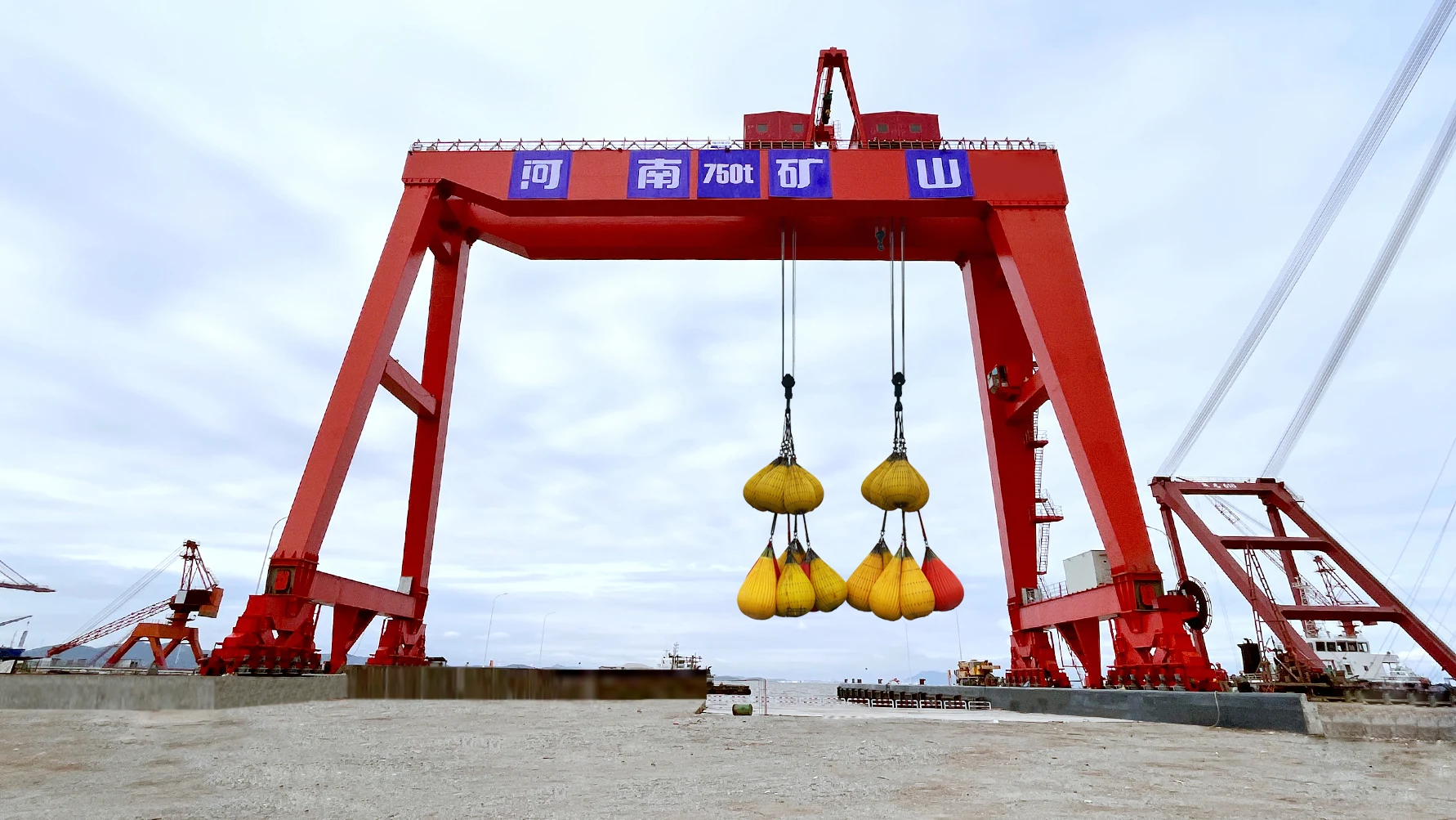
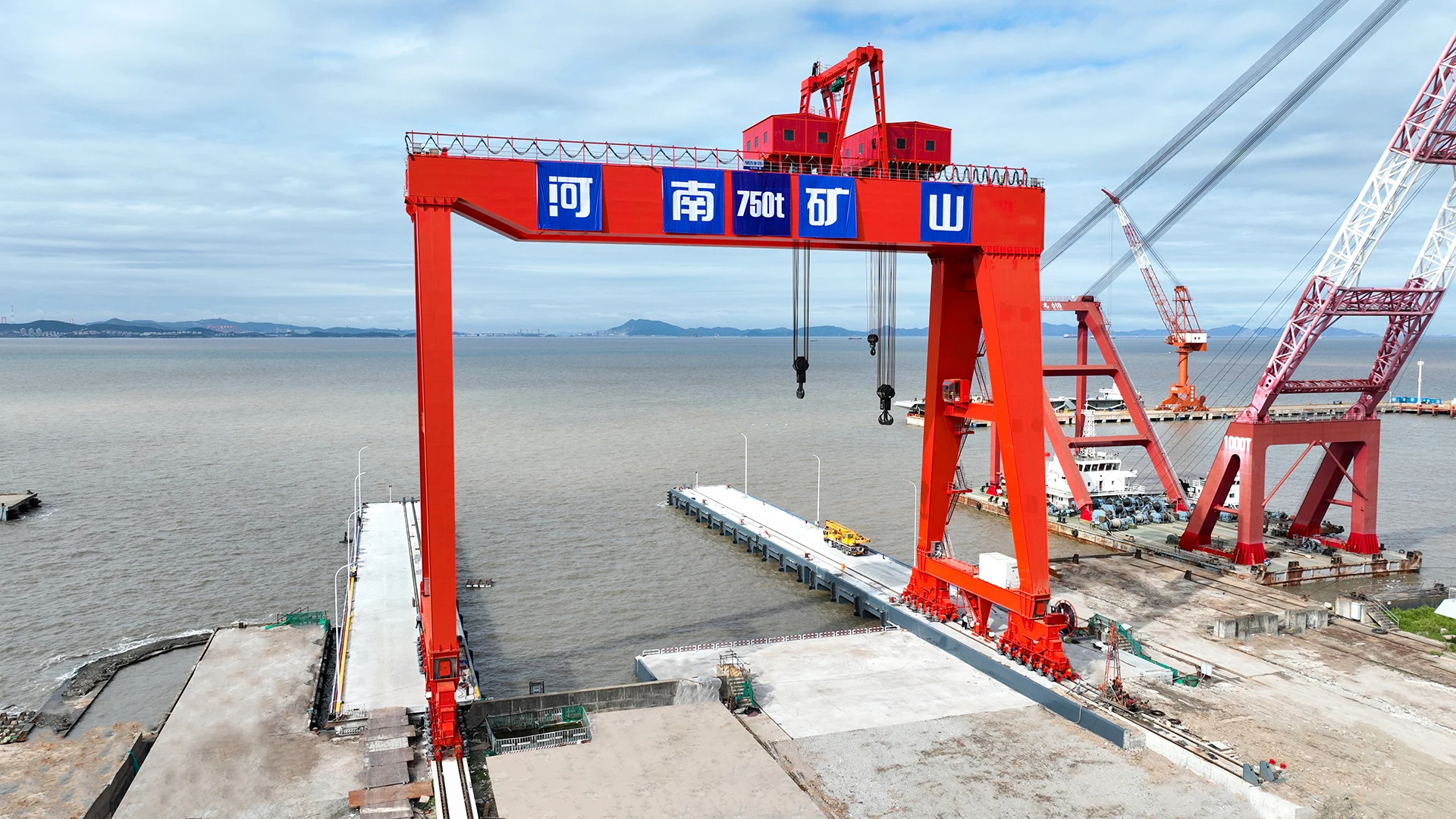
Coordinated lifting points and controlled travel are central to this 750t double-girder gantry crane, put into use for an unnamed project in Zhejiang. The configuration combines automatic balance adjustment, position control and a rail arrangement tailored to the site's loading conditions.

- Project
- Unnamed project in Zhejiang; crane put into use
- Rated capacity
- 750 t double-girder gantry crane
- Load coordination
- Multiple synchronized lifting points with automatic balance adjustment
- Rail arrangement
- Single-side twin-rail design to reduce bridge-travel wheel loading
- Control
- PLC/VFD communication, automatic positioning and whole-crane safety monitoring
- Electrical supply
- 10 kV high-voltage supply with energy recovery during lowering
Heavy lifting with coordinated load support
The 750 t gantry was built for a Zhejiang project and put into use there. Its multiple lifting points operate synchronously, with automatic balance adjustment. This configuration addresses the handling of heavy loads supported at several points rather than treating each lifting point as an independent movement.
For a new installation, the load drawing should show the intended support points and centre of gravity through the full lifting sequence. Any change of orientation or support condition belongs in that review. The maximum mass alone does not define how synchronized lifting must be controlled.
Single-side twin rails and automatic positioning
A single-side twin-rail arrangement was selected for the project's particular conditions, with the aim of reducing travel wheel loading. The crane also includes automatic positioning. These are separate design decisions: rail and wheel layout address load transfer to the supporting structure, while positioning addresses where the suspended load is brought.
Buyers evaluating a similar gantry should provide the available rail corridor and the foundation or support limits. Agree the required stopping locations and positioning tolerances independently. The correct arrangement depends on load distribution, site layout and travel requirements rather than a standard twin-rail label.
10 kV power and energy recovery on lowering
The installation uses a 10 kV electrical supply. During lowering, energy is recovered electrically. High-strength special steel is also identified in the structural design. For this installation, an energy saving of 25–30% was reported; the comparison baseline and operating cycle were not specified, so the historical result is not a general performance guarantee.
A proposed project needs its own power-interface review, including the available supply and the conditions for returning recovered energy. The lifting cycle is also relevant: the balance of loaded raising, loaded lowering and empty movements determines what an energy-recovery feature can contribute in service.
Specify monitoring and the operating envelope together
Whole-crane safety monitoring is paired with the motion-control system. For a purchaser, the useful next step is to identify which operating states, load conditions and movement limits must be visible to operators and maintainers. Those requirements should be connected to the selected lift plan and site operating procedures.
Define the load cases to be demonstrated, the permitted differences between lifting points and the conditions for automatic positioning. Include rail-interface checks and the electrical integration scope. This gives the project team concrete acceptance items for a very heavy gantry, while leaving the final structural and control design tied to the actual installation.
Application photographs
See the equipment and working context.
Photographs and accompanying illustrations from this application report. Open an image for a larger view.
Application reference: Henan Mine Crane Group official application report. Equipment and operating advice for a new project should be specified against your load, process and site.
Start the equipment discussion
Relevant equipment families.
Compare the equipment family with your operating duty. Final attachments, controls and protection follow the application requirements.
Double girder gantry cranes
Discuss a project-engineered heavy gantry using the full load plan, rail interfaces and electrical requirements.
View equipment options ↗Lifting attachments
Evaluate fixtures and load connections for the actual lifting points and permitted load-sharing conditions.
View equipment options ↗Plan a similar application
Build the specification
around your operation.
Share the heavy-load geometry and site interfaces to evaluate synchronized lifting, rail loading and the electrical scope.
- Maximum load, centre of gravity and all lifting-point positions
- Support changes and required synchronization during the lift sequence
- Available span, rail corridor and foundation/wheel-load limits
- Hook paths, stopping points and required positioning tolerance
- Available high-voltage supply and energy-recovery interface conditions
- Duty cycles, monitoring signals and acceptance load cases
Before you specify
Questions for
your project.
What information is needed for a multi-point lift?
Provide load mass, centre of gravity, lifting-point geometry and the complete movement sequence. These establish the load-sharing and synchronization requirements to be engineered.
Can the rail arrangement be copied to another site?
It must be reviewed against the new rail corridor, foundations and allowable wheel loading. The single-side twin-rail arrangement here was selected for particular project conditions.
How should regenerative lowering be specified?
Start with the available electrical supply, raising/lowering duty and the site's energy-return conditions. Include the power interface and operating cycle in the equipment enquiry.
Continue exploring
More industrial manufacturing applications.

Aluminium Process Cranes for Carbon Blocks, Feeding and Automated Anode Exchange
Three purpose-built configurations address carbon-block handling and aluminium electrolysis for an unnamed Baotou aluminium company. The package separates suction and feeding, anode stacking and multifunction potroom work.
Explore this application
400t Double-Girder Gantry Crane for Heavy Chemical-Equipment Manufacturing
More than 30 assorted cranes were built for a Shandong chemical-equipment manufacturer. The featured 400t double-girder gantry combines motion control, brake logic and operator monitoring for heavy fabrication handling.
Explore this application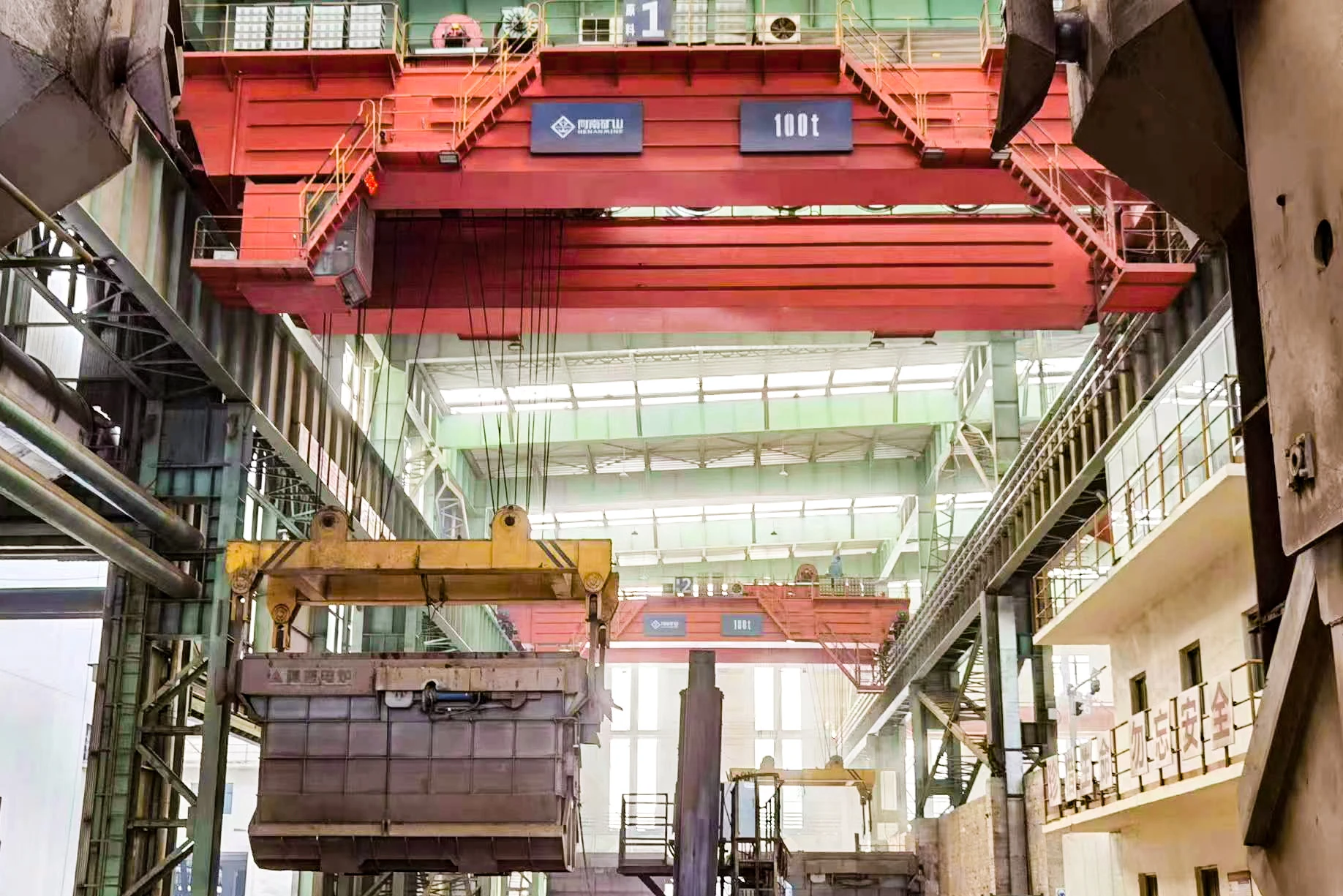
150-Plus Production-Line Cranes Including Two 100t Intelligent Units
More than 150 assorted cranes serve an unnamed plant's production lines, including two 100t intelligent units. A separate second-phase batch was still in manufacture at this supply milestone.
Explore this application


