
Trenchless machinery / Delivered factory equipment
Factory Cranes for Tangxing Pipe-Jacking Machine Manufacturing and Assembly
Pipe-jacking machine manufacturing at Tangxing Equipment combines heavy fabrication, assembly and transfers between production stations. Henan Mine Crane Group's delivered equipment forms part of a cooperation exceeding 100 assorted crane units/sets at the customer's trenchless-equipment industrial park.

- Customer
- Tangxing Equipment trenchless-machinery industrial park
- Reported stage
- Featured batch delivered and put into use
- Cooperation supply
- More than 100 assorted large-capacity crane units/sets
- Factory context
- Industrial park over 40,000 m²; heavy steel-structure factory 25 m high
- Production context
- Plant production scope of 500 pipe-jacking/tunnelling machines annually
- Wheel manufacturing
- Henan Mine Crane Group high-density crane-wheel near-net-shape forming technology
Heavy handling through the tunnelling-machine factory
Tangxing Equipment's factory produces pipe-jacking and tunnelling machines. A delivered crane batch joined the manufacturing park's handling equipment, with more than 100 assorted large-capacity units/sets built over the cooperation. The cranes support the production environment rather than the excavation of a tunnel at a construction site.
For another machinery manufacturer, the useful starting point is the component and assembly schedule. List the main fabrications, the stages at which they change support or orientation, and the places where finished assemblies leave a workstation. That reveals the lifting coverage needed along the production route.
Plan coverage within the actual building envelope
The industrial park covers more than 40,000 m², and the heavy steel-structure factory is 25 m high. These figures establish the scale of the customer's production setting. The 25 m building height is not a hook-lifting height, and the account gives no individual crane span or rated capacity.
A crane proposal needs building sections, rail levels and the load's required hook path. Large machinery may occupy substantial height during assembly, so the interface between crane, tooling and workpiece must be reviewed with the factory geometry. Available building height alone does not resolve that arrangement.
Wheel manufacturing as part of the equipment scope
The cooperation highlights Henan Mine Crane Group's high-density crane-wheel near-net-shape forming technology across its crane products. It is a manufacturing feature of the running equipment, alongside the stated focus on stable movement and positioning in the customer's plant.
Buyers can use the equipment enquiry to define wheel and rail interfaces, inspection requirements and the maintenance information needed for the factory. Any positioning tolerance or component-life requirement should be specified and verified for the chosen duty rather than inferred from the wheel-production method.
Separate factory production targets from crane duty
The park's stated production scope is 500 pipe-jacking machines a year. That number describes plant output, not crane capacity, crane production or measured lifting throughput. Crane duty is instead determined by how frequently particular components move and how long each assembly stage occupies the equipment.
Provide a workstation lift list with realistic cycle and access requirements. This allows the crane mix to be matched to heavy assembly tasks and recurring transfers, with acceptance checks based on the selected loads and routes. The result should be a station-specific handling plan for the proposed factory.
Application reference: Henan Mine Crane Group official application report. Equipment and operating advice for a new project should be specified against your load, process and site.
Start the equipment discussion
Relevant equipment families.
Compare the equipment family with your operating duty. Final attachments, controls and protection follow the application requirements.
Double girder overhead cranes
Evaluate for heavy fabrication and assembly stations using their load schedules, handling routes and building geometry.
View equipment options ↗Lifting attachments
Review machine-specific fixtures and orientation requirements from approved component and assembly drawings.
View equipment options ↗Plan a similar application
Build the specification
around your operation.
Share the pipe-jacking machine assembly sequence and factory sections to define the required crane coverage and lift mix.
- Component and assembly masses, dimensions and lifting interfaces
- Production-station map and transfer sequence between stations
- Building sections, rail elevations and required hook paths
- Turning/support changes and any coordinated-lift requirements
- Lift frequency, assembly occupancy and acceptance load cases
- Rail/wheel interfaces, inspection needs and maintenance access
Before you specify
Questions for
your project.
Can factory height be used as crane lifting height?
The hook path must be checked against rail level, crane headroom, tooling and the machine envelope. The 25 m figure here describes the building, rather than a specified lifting height.
How should cranes be selected for pipe-jacking machine assembly?
Provide the load and movement at each manufacturing stage, including support changes and transfer positions. Capacity and coverage should follow that workstation schedule.
What maintenance interfaces should be discussed early?
Rail and wheel compatibility, inspection points, component access and required spares information should be included with the production duty and factory layout.
Continue exploring
More industrial manufacturing applications.

Aluminium Process Cranes for Carbon Blocks, Feeding and Automated Anode Exchange
Three purpose-built configurations address carbon-block handling and aluminium electrolysis for an unnamed Baotou aluminium company. The package separates suction and feeding, anode stacking and multifunction potroom work.
Explore this application
400t Double-Girder Gantry Crane for Heavy Chemical-Equipment Manufacturing
More than 30 assorted cranes were built for a Shandong chemical-equipment manufacturer. The featured 400t double-girder gantry combines motion control, brake logic and operator monitoring for heavy fabrication handling.
Explore this application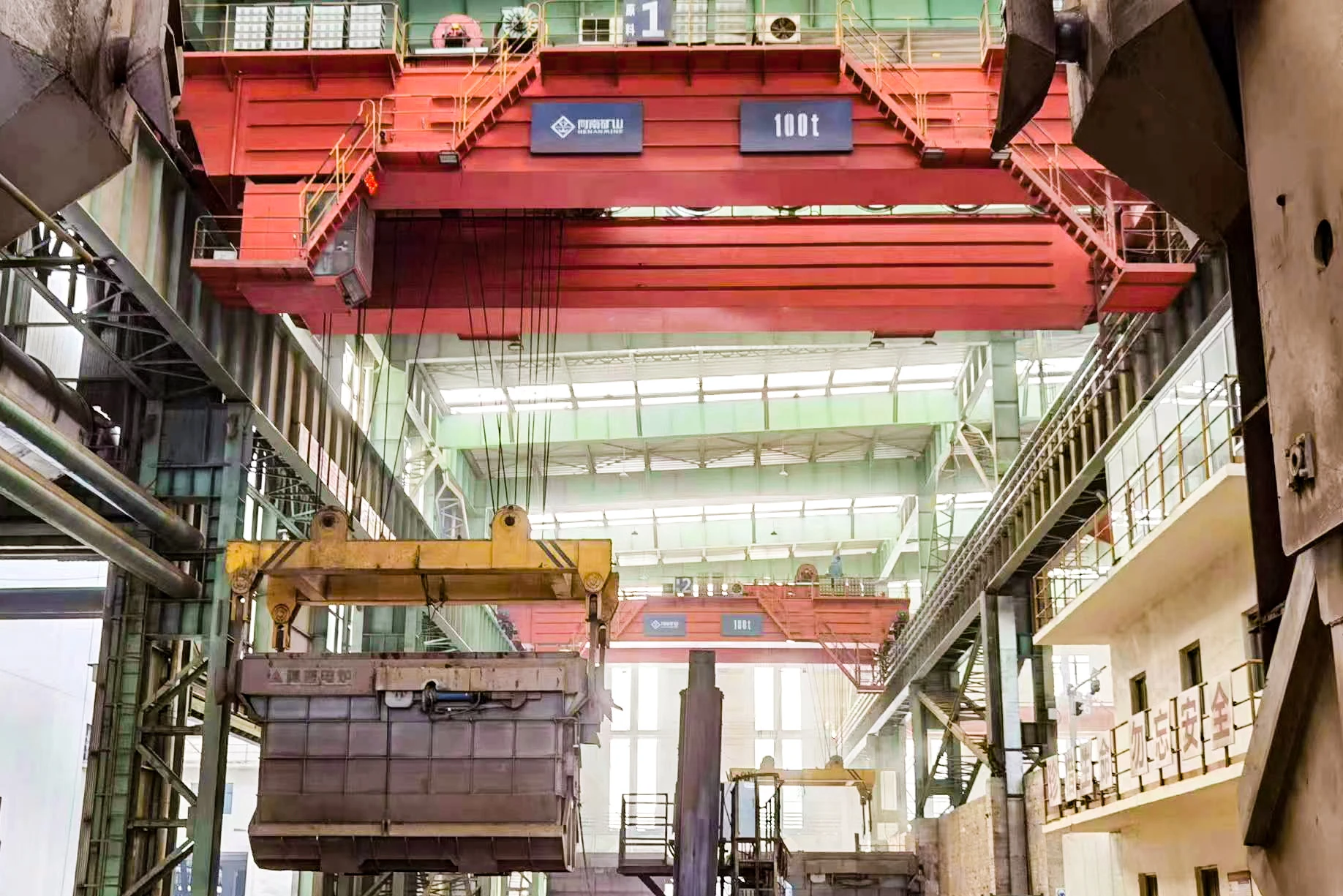
150-Plus Production-Line Cranes Including Two 100t Intelligent Units
More than 150 assorted cranes serve an unnamed plant's production lines, including two 100t intelligent units. A separate second-phase batch was still in manufacture at this supply milestone.
Explore this application


