
Mounting and support
Provide the beam/rail or crane-trolley geometry, orientation, route, stops and existing support drawings.
Compare the mounting interface, useful hook lift and itemized delivery scope for a 20 t wire-rope hoist enquiry.
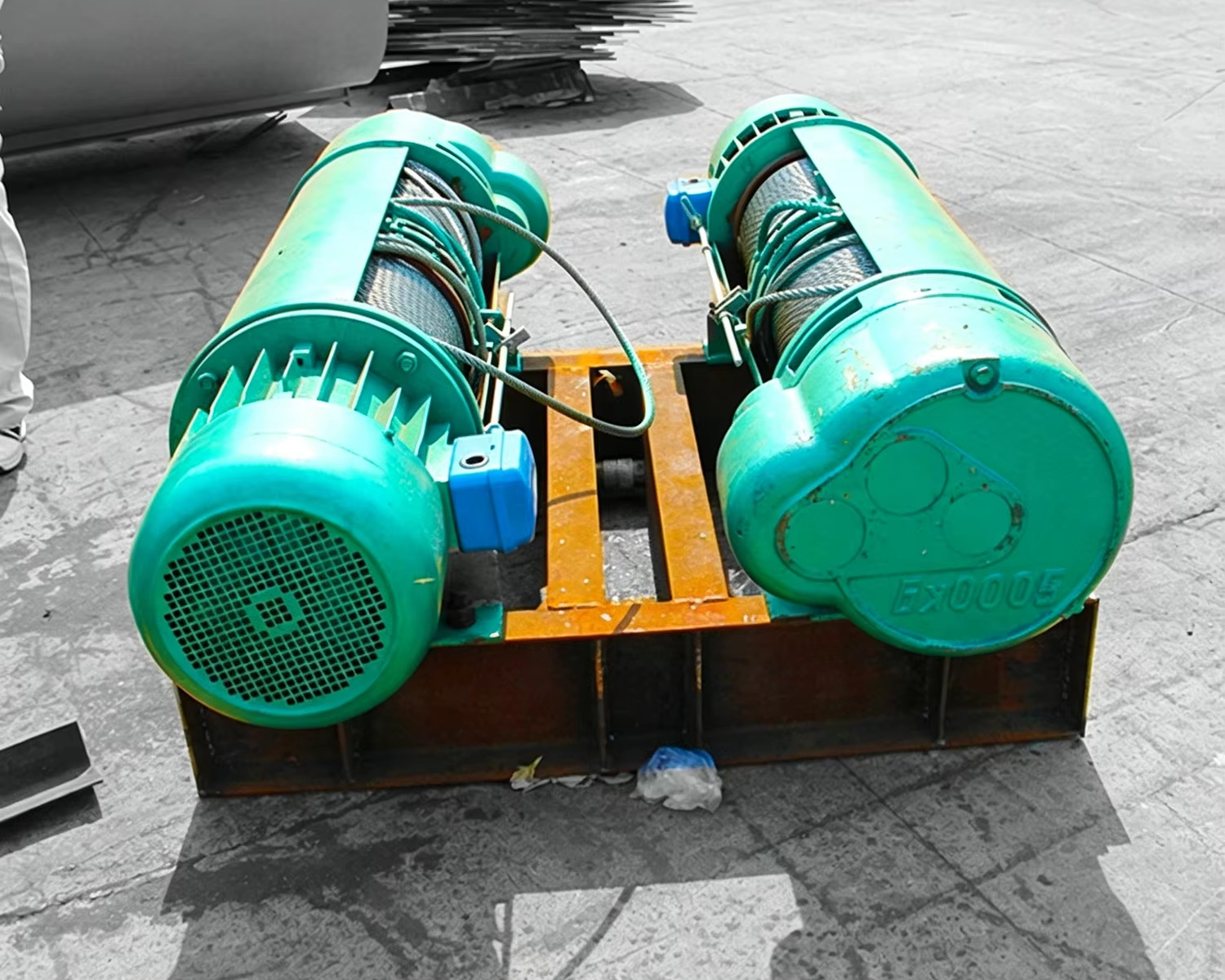
Two green wire-rope hoists on a pallet. This equipment-family view shows the assemblies; it does not identify a selected 20 t mounting arrangement or the number of units included in a quotation.
Enquiry reference; selected rating to agree
Start with your known requirements. Our team can clarify the remaining interfaces.
Separate the listed product information from the dimensions and responsibilities that need your project input.
| Enquiry reference | 20 t listing; selected hoist model, mounting and load cases to be agreed |
|---|---|
| Rated-load definition | Use the selected manufacturer’s rated-load definition. Include the payload and below-hook slings or lifting attachments as applicable; do not deduct the hoist’s built-in hook block again unless that rating definition requires it. Obtain hoist self-weight and support reactions separately for the beam and trolley design. |
| Mounting arrangement | Selected fixed, beam-running or crane-trolley interface; matching dimensions, orientation and fastenings |
| Useful hook lift | Required upper and lower working hook positions, measured on the selected reeving and hook-block arrangement |
| Headroom and approaches | Support reference level, upper-hook position, end approaches and space for load, rigging and service |
| Archived 20 t lift options | Supplier family schedule lists 9, 12 and 18 m; confirm the selected useful movement and dimensions |
| Archived 20 t motion options | Supplier family schedule lists 4 m/min lifting and 20 m/min travel; confirm the selected drives and operating limits |
| Duty and site power | Load spectrum, cycles, starts, shifts and local voltage/frequency/phase; selected equipment classification to agree |
| Support design input | Selected self-weight, wheel or mounting reactions, travel route and support drawings |
| Delivery package | Itemized assemblies, loose parts, package count, dimensions, masses and handling information |
| Site responsibilities | Allocated support work, moving power feed, unloading, installation, commissioning and inspection/testing |
| Handover documents | Matching arrangement/electrical drawings, manuals, agreed records, parts identification and service terms |
Listed information supports initial selection. Final dimensions, loads, speeds and components are defined in the project technical offer.
Provide the beam/rail or crane-trolley geometry, orientation, route, stops and existing support drawings.
Mark pickup and landing levels, required upper/lower hook positions, rigging/load sizes, headroom and approaches.
State package access and unloading constraints, site supply, installation access and purchaser-provided work.
| Work package | Agree in the quotation |
|---|---|
| Selected equipment | Identified hoist, suspension/trolley, reeving, hook block, drives, controls and agreed loose items. |
| Support and electrical work | Allocated structural review/support work, stops, moving feed, isolation and site wiring. |
| Delivery and installation | Named delivery term, package list, unloading, assembly, installation and commissioning responsibilities. |
| Acceptance and handover | Agreed inspection/testing, records, matching instructions, training, parts and contractual service terms. |
This is a scope-planning checklist. Inclusion and responsibility depend on the agreed contract.
Review the selected mounting drawing against working hook positions and site responsibilities.
Use the Site interfaces tab above to check the layout and operating conditions. Record your requirements in the project brief alongside this page.
Review the product configuration and purchasing requirements for this equipment.
For a 20 t wire-rope hoist enquiry, define what the equipment mounts to, the working hook positions and what arrives with the delivery. Compare the selected arrangement drawing with the site layout, then separate the hoist package from support work, power feed and installation. The supplier’s archived 20 t schedule provides listing alternatives; the project offer must identify the selected model, dimensions and operating limits.
MOUNT · LIFT · RECEIVE
Use the same interface drawing and supply boundaries when reviewing alternative offers.
State fixed or travelling use and provide the actual beam, rail or crane-trolley dimensions. Request the selected mounting detail, adjustment range, fastenings, self-weight and reactions for the responsible support designer.
Compare the upper and lower working hook positions with your pickup and landing levels. Check headroom, approaches, rigging height and load dimensions rather than treating a nominal rope or lifting-height option as usable clearance.
Ask which assemblies arrive complete and which parts are packed loose. Obtain the package list, handling dimensions and masses before arranging transport, unloading and access to the installation area.
CORRESPONDING PRODUCT PHOTOGRAPHS
These corresponding archive photographs show equipment-family and storage views. The selected drawing and package list define the supplied arrangement.
01 / EQUIPMENT-FAMILY REFERENCETwo green wire-rope hoists on a pallet. This equipment-family view shows the assemblies; it does not identify a selected 20 t mounting arrangement or the number of units included in a quotation.
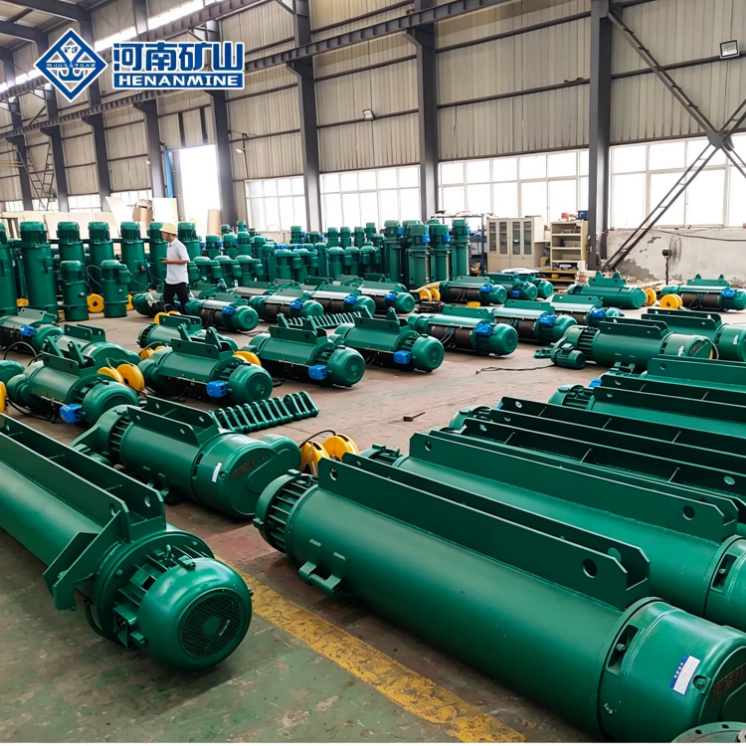 02 / EQUIPMENT-FAMILY REFERENCE
Green hoist assemblies on a workshop floor. Use the selected drawing and itemized package list to identify the equipment proposed for delivery; this storage view is not a project-delivery record.
 03 / EQUIPMENT-FAMILY REFERENCE
Yellow hook blocks, shafts and hoist components in workshop storage. The view helps identify component types, not the selected reeving, rated load or spare-parts scope.
ITEMIZE THE DELIVERY
The offer should identify the selected hoist, mounting or trolley parts, reeving, hook block, drives, controls and any separately packed items. List the beam or runway, moving power feed, isolation and site wiring as responsibility items.
Agree transport terms, unloading equipment, installation access, assembly, commissioning and inspection or testing. A photograph of two hoists or stored hook blocks does not establish the quantity or accessories included in your order.
REFERENCE LEVELS AND RESPONSIBILITIES
Show the support section, mounting orientation, required upper/lower hook positions, pickup and landing levels and available service space. Add access openings, unloading constraints and the work your site team will provide.
Discuss mounting, useful lift and deliveryHenan Mine Crane Group
Use matching equipment references and revision dates across the agreed documents.
Identify the model, rated load, useful hook movement, drives, controls, mounting dimensions and relevant operating limits. Resolve differences between a family schedule and the selected offer before ordering.
Obtain package identification, dimensions, masses, documented handling points and preservation instructions. Allocate support readiness, site power, assembly access and installation responsibilities.
Agree inspection and functional checks, applicable testing, records and training. Request matching instructions, electrical information and spare-part identification; state service and warranty terms in the contract.
Historical supplier-listing information for context. Request a current quotation for your selected configuration and project scope.
Range combines the price tiers shown in the saved listing. Captured 2026-10-13. This is not a current project quotation; capacity, dimensions, options, quantity, delivery and included services affect final price.
Archived supplier-listing reference. The saved price is not a current quotation; confirm configuration, quantity, shipping and included scope. View saved source listing ↗
Bring engineering, purchasing and the installation team into the same scope before the purchase order.
Send the support and mounting layout, required upper/lower hook positions, pickup and landing levels, load/rigging sizes and available headroom. Add site power, receiving access and installation responsibilities.
Send a drawing for reviewLoad or working task, layout, operating cycle, destination and timing.
Selected configuration, interface drawing, component schedule and scope exceptions.
Inspection, testing and documentation, delivery responsibilities and warranty terms.
No. Those values appear as alternatives in the archived 20 t family schedule. Compare the selected reeving and hook-block arrangement with the required upper and lower working hook positions. Mounting level, headroom, approaches, rigging and load dimensions affect whether the task fits.
The archived supplier family schedule lists those values in its 20 t row. They are listing alternatives rather than an approved project configuration. Ask the technical offer to state the selected drives, speeds, control method and applicable operating conditions.
It should identify the selected suspension or trolley, mounting orientation, matching support dimensions, fastenings or wheel geometry, useful hook positions, approaches and service access. Obtain equipment self-weight and reactions separately for the support review.
No. The photographs show hoist assemblies and workshop storage. Use an itemized quotation and package list to establish quantity, assembled and loose items, mounting parts, controls, accessories and spare parts. Allocate support work, power feed, unloading and installation separately.
The saved supplier listing captured 2026-10-13 shows US$1,500 per case for 1–2 cases and US$1,200 for at least 3 cases. These historical tiers are not a current or delivered quotation. Request an itemized offer for the selected equipment, quantity, packing, delivery and site services.
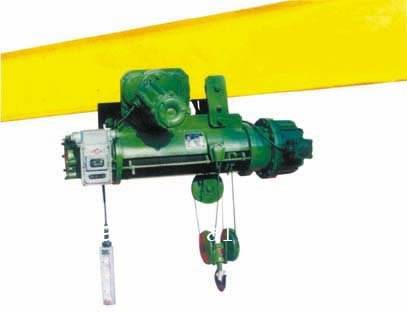
Trolley and load-envelope comparison: check beam fit and working clearances.

Drive-selection comparison: specify lifting and travel control separately.

Speed and trolley comparison: review the selected motion schedule.
 01
 02
 03
 04
 05
 06
 07
 08
EXPLORE OUR NEWSROOM
Projects, technology and updates
from Henan Mine Crane Group.
 01
Crane projects, dispatches and on-site applications.
 02
Equipment developments, engineering and manufacturing.
 03
Factory updates, partnerships and the people behind our cranes.
 04
Trade shows, industry meetings and company events.