
Travel path and supporting surface
Provide the yard layout, travel route, rail or floor arrangement and ground or foundation information. Confirm wheel loads and support requirements for the selected configuration.
Review the lifted load, working coverage and yard interfaces together with the selected rail-mounted, portable, semi-gantry or rubber-tyred arrangement.

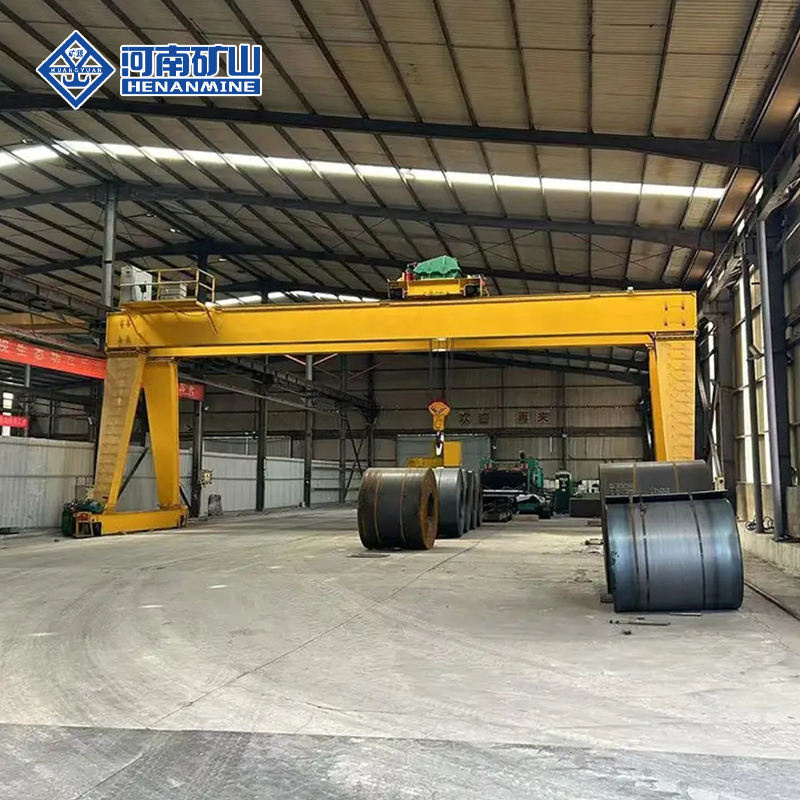
Yellow double-girder gantry with hook gear above a suspended load inside a bright hall
Listed rated capacity
Start with your known requirements. Our team can clarify the remaining interfaces.
Separate the listed product information from the dimensions and responsibilities that need your project input.
| Selected crane and delivery basis | Describe the goods, attachment and complete suspended loads in T, with ground rail-centre span and useful hook travel in m. Identify the intended site and lifting application. Ask for the selected gantry arrangement before using its proposed transport split as the basis for carrier and receiving quotations. |
|---|---|
| Proposed transport-piece schedule | Request a schedule of the proposed shipping pieces, each with an identity, description, packing condition, dimensions in mm and shipping mass in T. Ask which components are packed together and how they are identified. Use the selected schedule for delivery planning rather than treating total crane mass as a single shipping-piece mass. |
| Delivery route and site entrance | Provide the receiving address, delivery entrance and known access restrictions. Give relevant gate and route dimensions in mm and identify constraints that the carrier or site team must review. Ask the supplier to state the proposed shipment arrangement and the information still needed from the transport provider. |
| Unloading and receiving resources | Identify the planned receiving area and the parties expected to arrange unloading equipment, personnel and local services. Request the supplier’s piece information and applicable handling documents for review by those providers. Agree who selects and provides the receiving resources and who coordinates their readiness for delivery. |
| Storage and component protection | Describe the available storage areas, expected time before assembly and site exposure conditions. Ask for the supplier’s packing, storage and preservation information for the selected shipment. Allocate storage preparation, inspection on receipt and protection of delivered components within the agreed site scope. |
| Packing lists and delivery records | Request the packing list, piece markings, accompanying documents and records needed to reconcile the delivery with the order. Identify the receiving contact and how shortages, damage or document questions will be recorded and raised. Agree which records are available before dispatch and which travel with the shipment. |
| Delivery terms and later site work | Separate the agreed transport and receiving services from assembly, installation and commissioning services. Ask for the proposed delivery terms, dates and dependencies, with the responsible parties identified. Confirm the selected transport-piece information and any route or site changes before committing the corresponding resources. |
| Capacity and hook load | Include lifting tackle and any spreader, grab or other suspended attachment. |
| Bridge span and clearance | State rail gauge or work width, lift height, headroom and required hook approaches. |
| Travel path | Provide rail or tyre route, ground levels, travel distance and stopping positions. |
| Wheel reactions and support | Request selected wheel loads and horizontal forces for the specified operating cases. |
| Power and site conditions | Confirm supply, outdoor exposure, wind limits, foundations, access and installation boundary. |
Listed information supports initial selection. Final dimensions, loads, speeds and components are defined in the project technical offer.
Provide the yard layout, travel route, rail or floor arrangement and ground or foundation information. Confirm wheel loads and support requirements for the selected configuration.
Show the required span, leg clearance, overhang if applicable, hook approaches and upper and lower hook positions. Identify vehicle routes and nearby structures.
Declare wind, temperature, corrosion and exposure where applicable. Confirm power delivery, travel restrictions and the operating cycle in the technical offer.
| Work package | Agree in the quotation |
|---|---|
| Gantry equipment | Selected bridge, legs, hoist or trolley, travel arrangement, controls and specified safety functions. |
| Travel support and utilities | Rails or suitable supporting surface, foundations where applicable, power feed and site interfaces. |
| Delivery and installation | Named delivery term, unloading, installation work, local labour and access equipment. |
| Acceptance and handover | Inspection and test plan, records, documentation, training, spare parts and warranty terms. |
This is a scope-planning checklist. Inclusion and responsibility depend on the agreed contract.
Review the lifted load, working coverage and yard interfaces together with the selected rail-mounted, portable, semi-gantry or rubber-tyred arrangement.
Use the Site interfaces tab above to check the layout and operating conditions. Record your requirements in the project brief alongside this page.
Review the product configuration and purchasing requirements for this equipment.
Rail-Mounted Double-Girder Gantry Crane. Available rated-load options: 10T hook-load and arrangement request or 50T hook-load and arrangement request or 70T hook-load and arrangement request or 90T hook-load and arrangement request or 100T hook-load and arrangement request. A gantry crane carries a bridge and hoist on legs that travel on the specified ground rails or wheel path. Also specified as a gantry crane, this equipment can be configured for the work area and lifting task. A gantry arrangement can provide lifting coverage in a yard, production area or building where the selected support system suits the site. Common applications include outdoor storage and transfer yards and precast and fabrication areas. Select the configuration, working range, controls and supply scope for your operating conditions, then request a current, itemized quotation.
Confirm model, dimensions, duty, power supply, selected options, delivery and installation scope in the current technical offer.
START WITH THE LOAD
A gantry crane carries a bridge and hoist on legs that travel on the specified ground rails or wheel path. A gantry arrangement can provide lifting coverage in a yard, production area or building where the selected support system suits the site. Typical applications include outdoor storage and transfer yards, precast and fabrication areas, workshops and assembly sites. Compare the proposed configuration with the actual load, reach, duty and site dimensions.
Define the complete suspended load, bridge span, clearance below the girder and the working cycle.
Provide rail gauge or wheel path, ground levels, gradients, turns, stops, travel distance and access constraints.
Confirm support capacity, selected wheel reactions, power routing and site wind, weather or floor conditions as applicable.
Saved supplier listing captured 2026-10-13; quantity tiers: 1-4 sets: US$10,600 per set · 5-9 sets: US$10,000 per set · ≥10 sets: US$9,000 per set. The listing does not establish a current, project-specific or delivered price. Rated load, span, lifting height and gantry geometry affect the steel structure and mechanisms. Rail travel or tyre travel, drive arrangement and selected control system affect the package. Ground rails, foundations, power feed, erection and commissioning must be scoped for the site. Transport, quantity, environment and agreed accessories affect the project quotation.
SEE THE EQUIPMENT
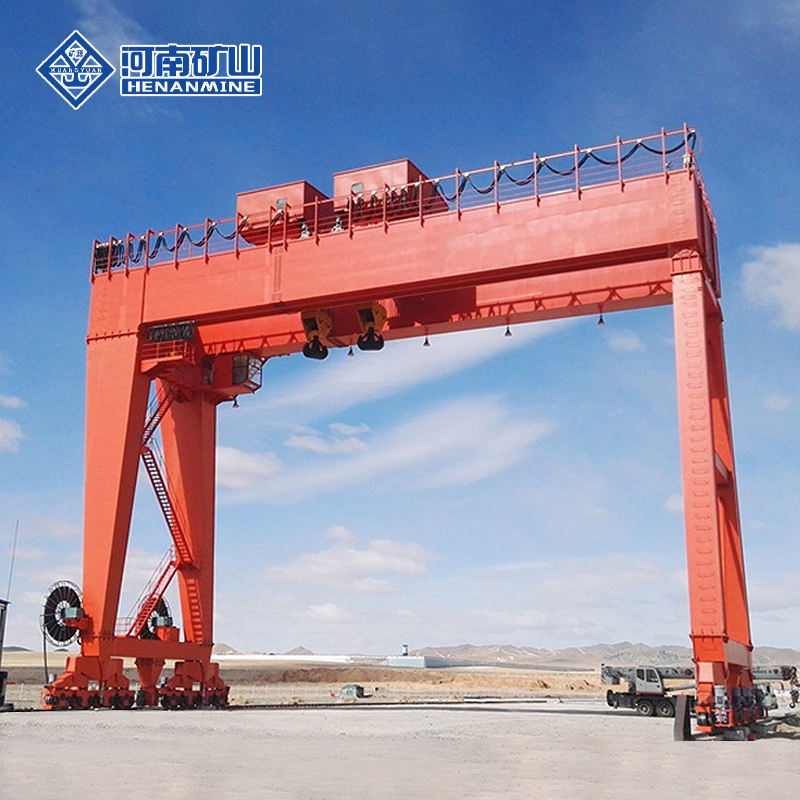
Review these rail-mounted double-girder gantry crane photographs alongside the requested operating conditions and layout. Visible equipment is a product-range reference; confirm the ordered configuration in the offer.
01 / RAIL-MOUNTED DOUBLE-GIRDER GANTRY CRANE · 01Yellow double-girder gantry with hook gear above a suspended load inside a bright hall. Define the complete suspended load, bridge span, clearance below the girder and the working cycle.
 02 / RAIL-MOUNTED DOUBLE-GIRDER GANTRY CRANE · 02
Yellow double-girder gantry cranes with upper walkways and cabins in an outdoor factory yard. Provide rail gauge or wheel path, ground levels, gradients, turns, stops, travel distance and access constraints.
 03 / RAIL-MOUNTED DOUBLE-GIRDER GANTRY CRANE · 03
Yellow gantry inside a coil storage building. Confirm support capacity, selected wheel reactions, power routing and site wind, weather or floor conditions as applicable.
State the work route, positioning needs and operator location. Confirm the selected cabin, pendant or radio arrangement, travel limits, speeds and cable or festoon routing for the offered model.
COMPARE THE COMPLETE PROPOSAL
Specify the equipment and services you need. Your quotation should identify what is included and what is priced separately.
Choose the equipment and services to include in the quotation. The final offer should state supplier and purchaser responsibilities for each site interface.
SITE DIMENSIONS · DUTY · EQUIPMENT SCOPE
Provide the layout and operating conditions to compare a rail-mounted double-girder gantry crane quotation against your actual project.
Discuss your siteHenan Mine Crane Group
Compare itemized quotations with the same equipment, delivery and site-service boundaries.
Confirm 10, 50, 70, 90 and 100 ton, selected mechanisms, control options and required accessories.
List rail or support work, power supply, clearances and purchaser-provided services.
State transport, unloading, erection, testing, commissioning and service parts included in the offer.
Historical supplier-listing information for context. Request a current quotation for your selected configuration and project scope.
Range combines the price tiers shown in the saved listing. Captured 2026-10-13. This is not a current project quotation; capacity, dimensions, options, quantity, delivery and included services affect final price.
Archived supplier-listing reference. The saved price is not a current quotation; confirm configuration, quantity, shipping and included scope. View saved source listing ↗
Bring engineering, purchasing and the installation team into the same scope before the purchase order.
Mark the travel path, working width, leg clearance, hook positions and load route. Include ground, rail or floor information and site access.
Send a drawing for reviewLoad or working task, layout, operating cycle, destination and timing.
Selected configuration, interface drawing, component schedule and scope exceptions.
Inspection, testing and documentation, delivery responsibilities and warranty terms.
A gantry crane carries a bridge and hoist on legs that travel on the specified ground rails or wheel path.
Load, span and lifting height: Define the complete suspended load, bridge span, clearance below the girder and the working cycle. Ground route and travel: Provide rail gauge or wheel path, ground levels, gradients, turns, stops, travel distance and access constraints. Include the rated load, dimensions, operating cycle, site interfaces and required supply scope.
US$9,000–10,600 per set is the saved supplier-listing reference, captured 2026-10-13. Rated load, span, lifting height and gantry geometry affect the steel structure and mechanisms. Rail travel or tyre travel, drive arrangement and selected control system affect the package. Ground rails, foundations, power feed, erection and commissioning must be scoped for the site. Transport, quantity, environment and agreed accessories affect the project quotation. Request a current quotation for the selected configuration, quantity, delivery and services.
Send the complete load, span, lift height, operating cycle, ground route, site power and required supply scope.
Inclusion depends on the offer. List rails, foundations, power supply, installation and commissioning separately when requesting comparable quotations.
Review configuration and project requirements
Review configuration and project requirements

Review configuration and project requirements
 01
 02
 03
 04
 05
 06
 07
 08
EXPLORE OUR NEWSROOM
Projects, technology and updates
from Henan Mine Crane Group.
 01
Crane projects, dispatches and on-site applications.
 02
Equipment developments, engineering and manufacturing.
 03
Factory updates, partnerships and the people behind our cranes.
 04
Trade shows, industry meetings and company events.