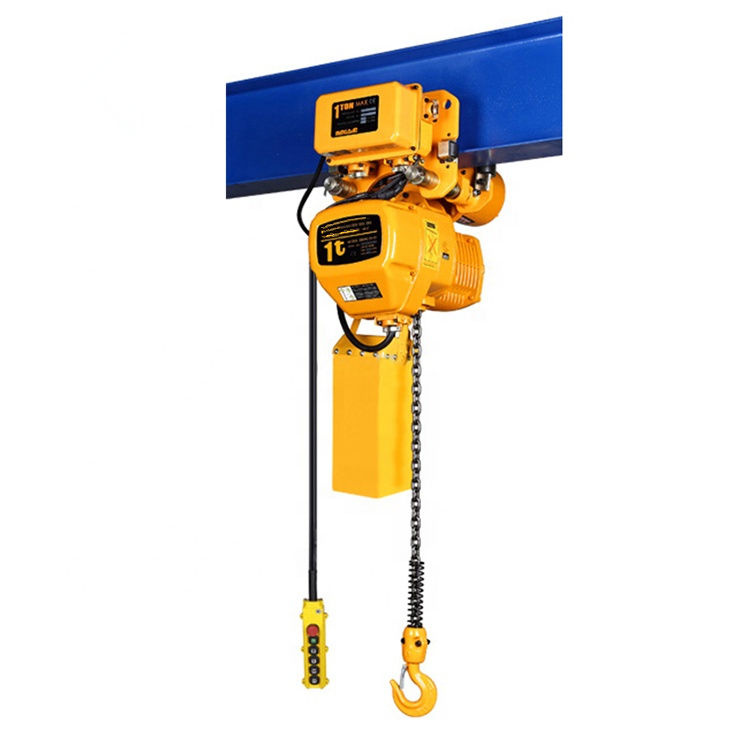
Mounting and supporting arrangement
Identify fixed, trolley, monorail or crane mounting. Provide beam or trolley dimensions, support information and the required installation orientation.
Match the hoisting mechanism to the complete lifted load, useful hook travel, mounting arrangement and operating cycle.
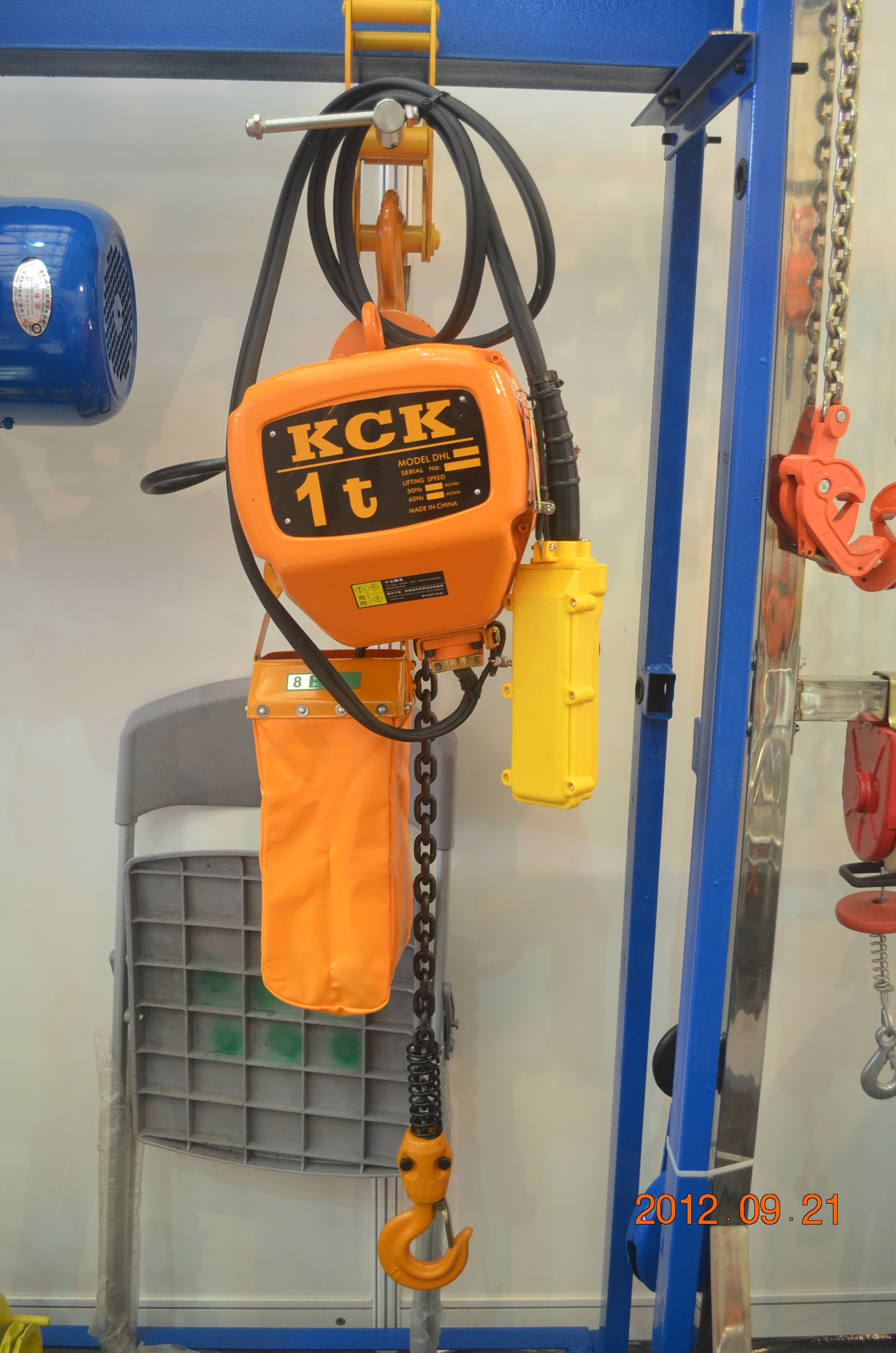
Orange electric chain hoist with hanging chain and hook beside a workshop test frame.
Listed lifting capacity
Start with your known requirements. Our team can clarify the remaining interfaces.
Separate the listed product information from the dimensions and responsibilities that need your project input.
| Selected rated assembly | Electric chain hoist, load chain, bottom hook and suspension/trolley selected for the complete load |
|---|---|
| Load basis | Workpiece, slings, fixtures and other below-hook accessories included in the capacity selection |
| Suspension type | Top-hook suspension or a compatible manual/electric beam trolley, as specified |
| Useful lifting height | Required upper/lower hook positions, headroom, chain reeving and load/rigging clearance agreed |
| Chain and container | Matched load chain, number of falls, chain length and storage/container clearance confirmed |
| Trolley interface | Beam section/flange width and thickness, trolley adjustment, wheel fit and travel stops checked when selected |
| Support interface | Suspension pin/hook or trolley reactions, supporting structure and installation orientation coordinated |
| Lifting and travel functions | Selected hoisting speeds, manual or powered travel and control functions specified by motion |
| Operating duty | Load spectrum, starts/lifts per hour, motion time and shifts used for motor/brake and duty selection |
| Controls and protective functions | Pendant/radio preference, control voltage, limits, overload and stopping functions itemised |
| Power and exposure | Voltage/phase/frequency, feed route, isolation, temperature, dust/moisture and location agreed |
| Order boundary | Hoist, suspension/trolley, controls, supporting work, installation, checks and service parts itemised |
Listed information supports initial selection. Final dimensions, loads, speeds and components are defined in the project technical offer.
Identify fixed, trolley, monorail or crane mounting. Provide beam or trolley dimensions, support information and the required installation orientation.
Provide upper and lower hook positions, available headroom, load dimensions and attachment height. Confirm the selected reeving and travel envelope.
State load cycles, starts, working shifts, voltage, frequency and control requirements. Declare the operating environment and any special protection requirements.
| Work package | Agree in the quotation |
|---|---|
| Hoisting equipment | Selected hoist, suspension or trolley arrangement, controls and specified lifting functions. |
| Supporting system | Beam or crane interfaces, travel path, power feed and the allocation of support work. |
| Delivery and installation | Named delivery term, unloading, installation work, local labour and access equipment. |
| Acceptance and handover | Inspection and test plan, records, documentation, training, spare parts and warranty terms. |
This is a scope-planning checklist. Inclusion and responsibility depend on the agreed contract.
Match the hoisting mechanism to the complete lifted load, useful hook travel, mounting arrangement and operating cycle.
Use the Site interfaces tab above to check the layout and operating conditions. Record your requirements in the project brief alongside this page.
Review the product configuration and purchasing requirements for this equipment.
Electric Chain Hoist. Listed rated load: 1, 2 and 3 ton. An electric chain hoist raises and lowers a suspended load with a chain, hook and selected fixed or trolley-mounted arrangement. Also specified as a electric hoist, this equipment can be configured for the work area and lifting task. Specifying chain falls, hook travel, beam fit and operating frequency helps buyers compare a complete chain-hoist package. Common applications include workstation and production-line lifting and monorail load transfer. Select the configuration, working range, controls and supply scope for your operating conditions, then request a current, itemized quotation.
Confirm model, dimensions, duty, power supply, selected options, delivery and installation scope in the current technical offer.
START WITH THE LOAD
An electric chain hoist raises and lowers a suspended load with a chain, hook and selected fixed or trolley-mounted arrangement. Specifying chain falls, hook travel, beam fit and operating frequency helps buyers compare a complete chain-hoist package. Typical applications include workstation and production-line lifting, monorail load transfer, replacement or upgrade of lifting equipment. Compare the proposed configuration with the actual load, reach, duty and site dimensions.
Specify complete load, rated hoist capacity, chain reeving, useful lifting height, headroom and upper/lower approach.
Provide beam section, flange width, trolley type, travel path, support and available clearances.
State starts per hour, operating shifts, lift/travel speeds, pendant or radio control and site electrical supply.
Saved supplier listing captured 2026-10-13; quantity tiers: 1-9 sets: US$318.6 per set · ≥10 sets: US$259.88 per set. The listing does not establish a current, project-specific or delivered price. Rated load, lifting height, hoist type and reeving affect the hoist selection. Trolley, beam compatibility, travel drive and headroom requirements affect the supplied package. Duty class, speed, controls and electrical protection must match the operating site. Beam or runway work, installation, spares, quantity and delivery are confirmed separately as required.
SEE THE EQUIPMENT
Review these electric chain hoist photographs alongside the requested operating conditions and layout. Visible equipment is a product-range reference; confirm the ordered configuration in the offer.
01 / ELECTRIC CHAIN HOIST · 01Orange electric chain hoist with hanging chain and hook beside a workshop test frame. Include rigging in the lifted load and specify required upper/lower hook positions and operating cycle. Specify complete load, rated hoist capacity, chain reeving, useful lifting height, headroom and upper/lower approach.
 02 / ELECTRIC CHAIN HOIST · 02
Orange and blue electric chain hoists hanging from yellow workshop beams. Agree beam fit, suspension, wheel adjustment, headroom and service access for the selected hoist. Provide beam section, flange width, trolley type, travel path, support and available clearances.
03 / ELECTRIC CHAIN HOIST · 03Orange electric chain hoist with hanging chain and hook beside a workshop test frame. Confirm speed selection, limits, power supply, inspection access and replacement components in the offer. State starts per hour, operating shifts, lift/travel speeds, pendant or radio control and site electrical supply.
Specify fixed or travelling use, lifting and travel speeds, operator position and stopping accuracy. Confirm pendant or radio controls and the compatible beam or supporting crane in the quotation.
COMPARE THE COMPLETE PROPOSAL
Specify the equipment and services you need. Your quotation should identify what is included and what is priced separately.
Choose the equipment and services to include in the quotation. The final offer should state supplier and purchaser responsibilities for each site interface.
SITE DIMENSIONS · DUTY · EQUIPMENT SCOPE
Provide the layout and operating conditions to compare a electric chain hoist quotation against your actual project.
Discuss your suspension and trolley optionsHenan Mine Crane Group
Compare itemized quotations with the same equipment, delivery and site-service boundaries.
Confirm 1, 2 and 3 ton, selected mechanisms, control options and required accessories.
List rail or support work, power supply, clearances and purchaser-provided services.
State transport, unloading, erection, testing, commissioning and service parts included in the offer.
Historical supplier-listing information for context. Request a current quotation for your selected configuration and project scope.
Range combines the price tiers shown in the saved listing. Captured 2026-10-13. This is not a current project quotation; capacity, dimensions, options, quantity, delivery and included services affect final price.
Archived supplier-listing reference. The saved price is not a current quotation; confirm configuration, quantity, shipping and included scope. View saved source listing ↗
Bring engineering, purchasing and the installation team into the same scope before the purchase order.
Show the supporting beam or mounting arrangement, useful hook positions, available headroom and load. Include the electrical supply and travel requirements.
Send a drawing for reviewLoad or working task, layout, operating cycle, destination and timing.
Selected configuration, interface drawing, component schedule and scope exceptions.
Inspection, testing and documentation, delivery responsibilities and warranty terms.
An electric chain hoist raises and lowers a suspended load with a chain, hook and selected fixed or trolley-mounted arrangement.
Load, chain falls and lift: Specify complete load, rated hoist capacity, chain reeving, useful lifting height, headroom and upper/lower approach. Beam and trolley fit: Provide beam section, flange width, trolley type, travel path, support and available clearances. Include the Rated hoist load, dimensions, operating cycle, site interfaces and required supply scope.
US$259.88–318.6 per set is the saved supplier-listing reference, captured 2026-10-13. Rated load, lifting height, hoist type and reeving affect the hoist selection. Trolley, beam compatibility, travel drive and headroom requirements affect the supplied package. Duty class, speed, controls and electrical protection must match the operating site. Beam or runway work, installation, spares, quantity and delivery are confirmed separately as required. Request a current quotation for the selected configuration, quantity, delivery and services.
Compare rated load, lifting height, duty, speed, operating frequency, mounting and maintenance needs against the selected model specifications.
Provide beam section and flange dimensions, supporting details and the required trolley route so compatibility and wheel loads can be checked.
 01
 02
 03
 04
 05
 06
 07
 08
EXPLORE OUR NEWSROOM
Projects, technology and updates
from Henan Mine Crane Group.
 01
Crane projects, dispatches and on-site applications.
 02
Equipment developments, engineering and manufacturing.
 03
Factory updates, partnerships and the people behind our cranes.
 04
Trade shows, industry meetings and company events.