Load path and rope arrangement
Describe whether the duty is lifting or pulling. Provide reeving, sheave positions, line angles, required rope length and the load cases over the full route.
Define the lifting or pulling task, line force, rope length, speed and mounting interfaces before selecting the winch arrangement.

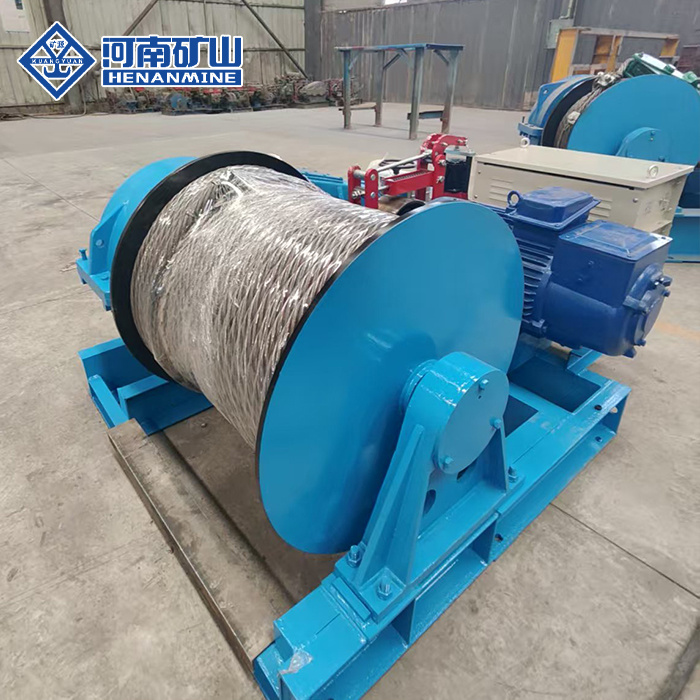
Blue electric winch with wound wire-rope drum and motor on a workshop floor.
Listed load / pulling requirement
Start with your known requirements. Our team can clarify the remaining interfaces.
Separate the listed product information from the dimensions and responsibilities that need your project input.
| Equipment arrangement | JM project-selected electric motor, reduction gearbox, drum, brake and mounting base |
|---|---|
| Required line pull | Force at the rope and reference drum layer agreed from the route, resistance or complete reeved lifting system |
| Layer performance | Line pull and speed schedule covers the rope layers used through the operating cycle |
| Rope travel and storage | Usable travel, required retained wraps, drum storage and rope exit agreed together |
| Rope specification | Diameter, construction/grade, termination, bending/sheave compatibility and winding conditions specified |
| Drum and rope lead | Drum geometry, lead angle, lead-sheave location and any guiding/spooling equipment reviewed |
| Working speed and duty | Target rope speed, starting/stopping frequency, cycle, shift use and thermal requirements selected |
| Brake and holding function | Stopping, holding, release and power-loss behaviour defined for the exact pulling or lifting task |
| Control arrangement | Operator location, wired/radio controls, motion functions, limits/interlocks and stopping sequence itemised |
| Mounting interface | Base footprint, anchorage, rope direction, installation reactions and maintenance clearances supplied |
| Electrical and exposure | Voltage, phase, frequency, feed/isolation, temperature, dust/water and operating location agreed |
| Delivery and integration scope | Winch, rope, sheaves, support work, power, installation, checks and operating documents itemised |
Listed information supports initial selection. Final dimensions, loads, speeds and components are defined in the project technical offer.
Describe whether the duty is lifting or pulling. Provide reeving, sheave positions, line angles, required rope length and the load cases over the full route.
Provide the installation layout, supporting structure and available space. Confirm mounting reactions, drum access, guarding and drive requirements.
State operating cycle, line speed, starts, hold requirements, power supply and control method. Agree the applicable braking and protection functions in the technical offer.
| Work package | Agree in the quotation |
|---|---|
| Winch equipment | Selected drum, rope storage, drive, braking arrangement and controls as specified. |
| Installation interfaces | Supports, anchorage, rope route, sheaves or reeving equipment and power supply. |
| Delivery and installation | Named delivery term, unloading, installation work, local labour and access equipment. |
| Acceptance and handover | Inspection and test plan, records, documentation, training, spare parts and warranty terms. |
This is a scope-planning checklist. Inclusion and responsibility depend on the agreed contract.
Define the lifting or pulling task, line force, rope length, speed and mounting interfaces before selecting the winch arrangement.
Use the Site interfaces tab above to check the layout and operating conditions. Record your requirements in the project brief alongside this page.
Review the product configuration and purchasing requirements for this equipment.
Electric Cable-Pulling Winch. Listed rated load: 35, 45 and 100 ton. An electric winch pulls or lifts a connected load using a driven rope drum, with line pull and rope arrangement selected for the task. Also specified as a electric winch, this equipment can be configured for the work area and lifting task. A correctly specified drum, drive, brake and rope route helps match the winch to the required pulling force, travel and mounting conditions. Common applications include equipment pulling and positioning and rope-operated lifting applications. Select the configuration, working range, controls and supply scope for your operating conditions, then request a current, itemized quotation.
Confirm model, dimensions, duty, power supply, selected options, delivery and installation scope in the current technical offer.
START WITH THE LOAD
An electric winch pulls or lifts a connected load using a driven rope drum, with line pull and rope arrangement selected for the task. A correctly specified drum, drive, brake and rope route helps match the winch to the required pulling force, travel and mounting conditions. Typical applications include equipment pulling and positioning, rope-operated lifting applications, industrial line handling. Compare the proposed configuration with the actual load, reach, duty and site dimensions.
State the required pull at the working drum layer, load direction, reeving and any sheaves or attachments.
Provide useful travel, required rope length, reserve wraps, drum layers, starting frequency and selected rope speed.
Share base dimensions, support and anchor loads, operating cycle, brake requirements and site voltage, frequency and phase.
Saved supplier listing captured 2026-10-12; quantity tiers: 1-4 sets: US$1,400 per set · 5-9 sets: US$1,200 per set · ≥10 sets: US$900 per set. The listing does not establish a current, project-specific or delivered price. Working line pull, drum capacity, rope diameter and number of layers affect the winch configuration. Drive power, speed, brake, control and duty influence the equipment package. Sheaves, rope guides, base, anchors, power supply and installation vary by application. Quantity, delivery and project testing scope are confirmed in the quotation.
SEE THE EQUIPMENT
Review these electric cable-pulling winch photographs alongside the requested operating conditions and layout. Visible equipment is a product-range reference; confirm the ordered configuration in the offer.
01 / ELECTRIC CABLE-PULLING WINCH · 01Blue electric winch with wound wire-rope drum and motor on a workshop floor. Specify line pull, rope length, reeving, slope and resisting forces for the task. State the required pull at the working drum layer, load direction, reeving and any sheaves or attachments.
 02 / ELECTRIC CABLE-PULLING WINCH · 02
Blue electric winch assembly with gearbox, drum, brake and control cabinet in a workshop. Agree rope diameter, drum layers, speed, braking and inspection space on the selected equipment. Provide useful travel, required rope length, reserve wraps, drum layers, starting frequency and selected rope speed.
 03 / ELECTRIC CABLE-PULLING WINCH · 03
Electric winch with blue motor, black drum and white control cabinet on a workshop base. Confirm foundation reactions, mounting bolts, fleet angle, guards, supply and operator position. Share base dimensions, support and anchor loads, operating cycle, brake requirements and site voltage, frequency and phase.
Describe the load path, operating direction, speed, stopping requirements and operator position. Confirm the selected brake, limits, controls and rope guide arrangement with the winch package.
COMPARE THE COMPLETE PROPOSAL
Specify the equipment and services you need. Your quotation should identify what is included and what is priced separately.
Choose the equipment and services to include in the quotation. The final offer should state supplier and purchaser responsibilities for each site interface.
SITE DIMENSIONS · DUTY · EQUIPMENT SCOPE
Provide the layout and operating conditions to compare a electric cable-pulling winch quotation against your actual project.
Discuss your rope route and mounting layoutHenan Mine Crane Group
Compare itemized quotations with the same equipment, delivery and site-service boundaries.
Confirm 35, 45 and 100 ton, selected mechanisms, control options and required accessories.
List rail or support work, power supply, clearances and purchaser-provided services.
State transport, unloading, erection, testing, commissioning and service parts included in the offer.
Historical supplier-listing information for context. Request a current quotation for your selected configuration and project scope.
Range combines the price tiers shown in the saved listing. Captured 2026-10-12. This is not a current project quotation; capacity, dimensions, options, quantity, delivery and included services affect final price.
Archived supplier-listing reference. The saved price is not a current quotation; confirm configuration, quantity, shipping and included scope. View saved source listing ↗
Bring engineering, purchasing and the installation team into the same scope before the purchase order.
Show the complete load path, rope route, sheaves, mounting arrangement, line angles and required rope storage. Identify lifting or pulling duty.
Send a drawing for reviewLoad or working task, layout, operating cycle, destination and timing.
Selected configuration, interface drawing, component schedule and scope exceptions.
Inspection, testing and documentation, delivery responsibilities and warranty terms.
An electric winch pulls or lifts a connected load using a driven rope drum, with line pull and rope arrangement selected for the task.
Line pull and working load: State the required pull at the working drum layer, load direction, reeving and any sheaves or attachments. Rope travel, storage and speed: Provide useful travel, required rope length, reserve wraps, drum layers, starting frequency and selected rope speed. Include the rated load, dimensions, operating cycle, site interfaces and required supply scope.
US$900–1,400 per set is the saved supplier-listing reference, captured 2026-10-12. Working line pull, drum capacity, rope diameter and number of layers affect the winch configuration. Drive power, speed, brake, control and duty influence the equipment package. Sheaves, rope guides, base, anchors, power supply and installation vary by application. Quantity, delivery and project testing scope are confirmed in the quotation. Request a current quotation for the selected configuration, quantity, delivery and services.
State the required line pull at the working drum layer and the reeving arrangement. A nominal lifting or pulling tonnage alone does not define available rope force.
Specify working travel, dead wraps, reserve length, reeving, rope diameter and the selected drum-layer arrangement.
 01
 02
 03
 04
 05
 06
 07
 08
EXPLORE OUR NEWSROOM
Projects, technology and updates
from Henan Mine Crane Group.
 01
Crane projects, dispatches and on-site applications.
 02
Equipment developments, engineering and manufacturing.
 03
Factory updates, partnerships and the people behind our cranes.
 04
Trade shows, industry meetings and company events.