Load route and hook positions
Show the complete suspended load, lifting attachments, pickup and set-down points, required upper/lower hook positions, side/end approaches and obstructions. Use these workpoints to define the motion requirements.
Specify variable-frequency drive requirements separately for hoisting, trolley and bridge travel. Link each motion to the load, workpoints, operating cycle and site electrical supply.

Upward view of a compact hoist and trolley beneath a yellow girder. Family reference photograph; specify the selected hoist rating, speed range and drive arrangement in the motion schedule.
Listed family options; selected configuration to be agreed
Start with your known requirements. Our team can clarify the remaining interfaces.
Separate the listed product information from the dimensions and responsibilities that need your project input.
| Rating options | 1 / 2 / 3 / 5 / 10 / 16 / 20 t listed; select from complete suspended load |
|---|---|
| Bridge arrangement | LDC single-girder box-beam family; selected bridge and hoist arrangement agreed |
| Span reference | 10.5–31.5 m listed; selected span and hook coverage defined by project drawing |
| Hook travel | Required upper/lower hook positions, rigging allowance and obstructions supplied |
| Duty basis | A5 listed for crane family; structure and mechanism classes verified against load cycle |
| Hoisting schedule | Selected hoist rating, speeds, drive method, brakes and limits specified separately |
| Travel schedule | Trolley and bridge speeds, drive method, acceleration, stopping and limits stated for each motion |
| Electrical and controls | Site voltage, phases, frequency, operator controls and feed responsibilities agreed |
| Handover package | Selected drive references, wiring, parameter backup, manuals and commissioning scope agreed |
Listed information supports initial selection. Final dimensions, loads, speeds and components are defined in the project technical offer.
Show the complete suspended load, lifting attachments, pickup and set-down points, required upper/lower hook positions, side/end approaches and obstructions. Use these workpoints to define the motion requirements.
State load spectrum, lifts per hour, starts, working shifts, travel distances and required speeds. Agree the proposed drive method, acceleration, stopping, limits and operator functions for each motion; list structure and mechanism duty separately.
Provide rail/support drawings, rail-top level and site voltage, phases and frequency. Request the selected wheel reactions and interface dimensions. Allocate the moving feed, isolation, cable route, installation and operating environment.
| Work package | Agree in the quotation |
|---|---|
| Crane and motion drives | Selected bridge, hoist, trolley and travel drives, controls and agreed safety functions itemized. |
| Runway and electrical feed | Rails, supports, moving power feed, isolation, cable routes and connection responsibilities allocated. |
| Delivery and site services | Delivery term, unloading, erection, electrical work, commissioning and purchaser inputs listed. |
| Documents and handover | Selected drive schedule, wiring, parameter backup, agreed inspection/test records, manuals and spares identified. |
This is a scope-planning checklist. Inclusion and responsibility depend on the agreed contract.
Map the pickup and set-down positions, travel distances and operating cycle before selecting speeds and control functions for each motion.
Use the Site interfaces tab above to check the layout and operating conditions. Record your requirements in the project brief alongside this page.
Review the product configuration and purchasing requirements for this equipment.
For an LDC single-girder crane enquiry, define hoisting, trolley travel and bridge travel separately. State the load, workpoints, operating cycle and required speeds, then compare how each motion is driven and controlled. A motion schedule makes the proposed variable-frequency drive scope, operator functions and electrical interfaces clear before ordering.
Confirm model, dimensions, duty, power supply, selected options, delivery and installation scope in the current technical offer.
SPECIFY EACH MOTION
A reference to VFD control does not identify which motions use it. Ask for a separate line for hoisting, trolley travel and bridge travel, with the proposed drive method and operating requirements for each.
State the complete suspended load, hook travel, required lifting and positioning speeds, load spectrum and starts. Ask the supplier to identify the hoist motor, drive method, braking arrangement and limits for that duty.
Show the pickup and set-down positions across the bay, side approaches and obstructions. Specify the travel and positioning speeds and ask for acceleration, stopping and end-limit functions in the selected proposal.
Provide the runway travel length, rail and support arrangement, stops and workpoints. Ask how the travel drives are coordinated and how the moving electrical feed interfaces with the building supply.
READ THE ARRANGEMENT
These photographs show family equipment arrangements. They do not identify an inverter model or prove that all motions use variable-frequency control.
01 / FAMILY REFERENCEUpward view of a compact hoist and trolley beneath a yellow girder. Family reference photograph; specify the selected hoist rating, speed range and drive arrangement in the motion schedule.
 02 / FAMILY REFERENCE
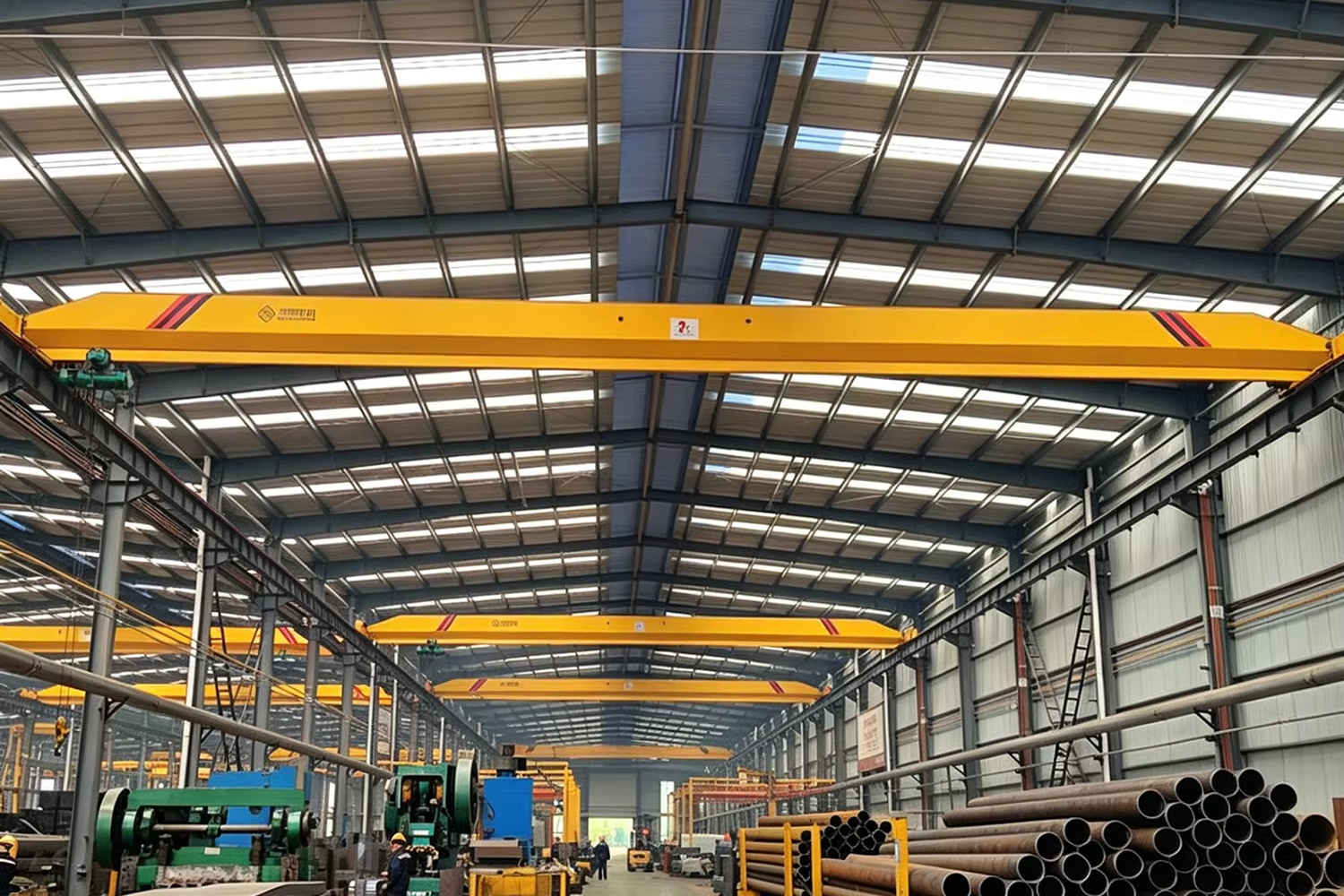
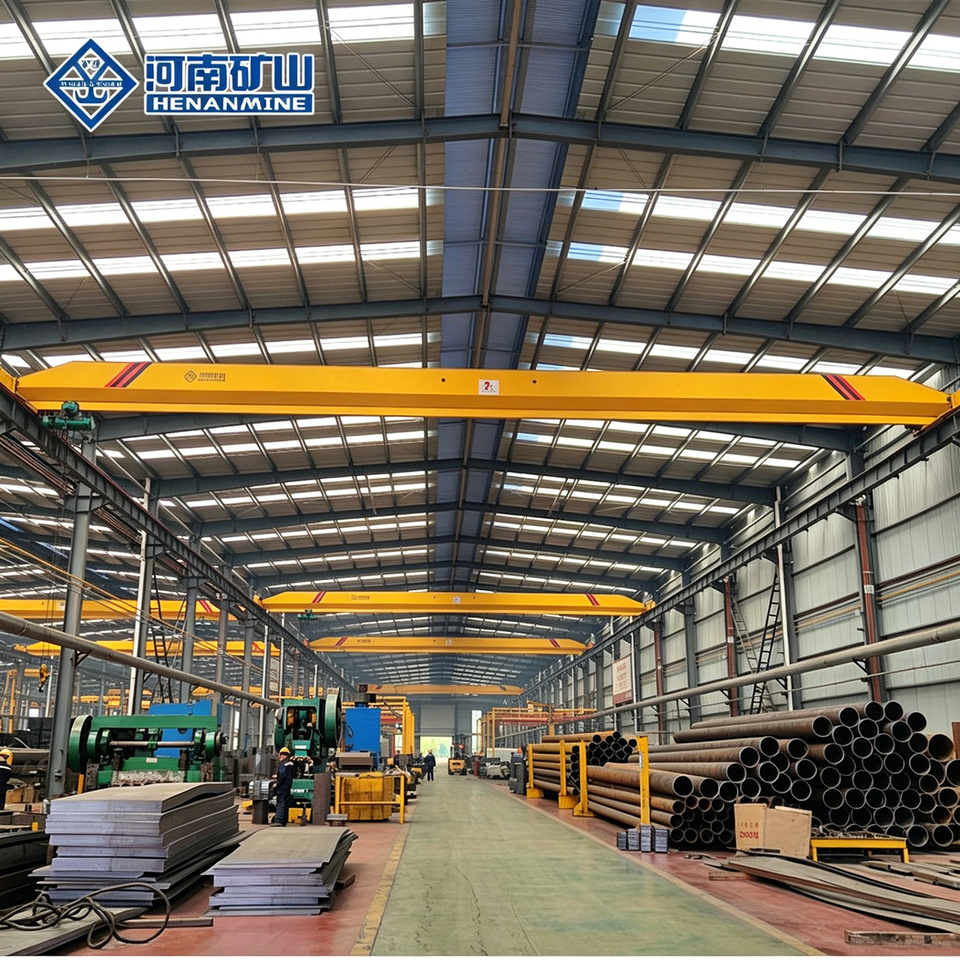
Workshop overview with several yellow bridges and machine tools. Family reference photograph; use the project layout to define bridge travel, hook coverage and the power-feed route.
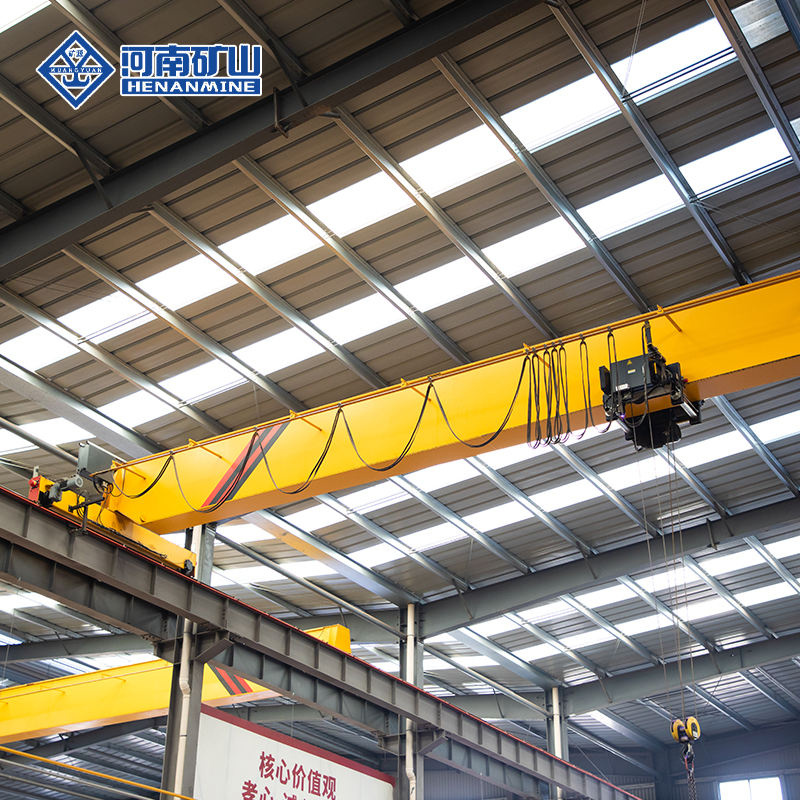 03 / FAMILY REFERENCE
Girder and hoist viewed from below with trailing cables and a hanging hook. Family reference photograph; confirm the selected trolley envelope, cable arrangement and maintenance access.
DEFINE THE ELECTRICAL BOUNDARY
Identify the selected drives, panel, operator controls, moving feed, isolation and connection work. State site voltage, phases, frequency, cable route and operating environment. Separate equipment supply from installation, commissioning and any purchaser-provided electrical work; the Supply scope tab gives the allocation checklist.
SET THE WORKPOINTS
Mark rail centres and rail-top levels, required upper and lower hook positions, side and end approaches, machines, columns and service obstructions. Provide runway and support drawings for review of the selected wheel reactions and interface dimensions.
Discuss your motion and layout requirementsAGREE THE HANDOVER
List the agreed equipment and drive schedule, wiring diagrams, parameter backup, operating instructions, maintenance information and spare-part references. Define factory and site checks, commissioning responsibilities and operator handover in the order documents. Any positioning or stopping acceptance criteria need their own agreed method and conditions.
Historical supplier-listing information for context. Request a current quotation for your selected configuration and project scope.
Range combines the price tiers shown in the saved listing. Captured 2026-10-13. This is not a current project quotation; capacity, dimensions, options, quantity, delivery and included services affect final price.
Archived supplier-listing reference. The saved price is not a current quotation; confirm configuration, quantity, shipping and included scope. View saved source listing ↗
Bring engineering, purchasing and the installation team into the same scope before the purchase order.
Mark the runway, span, hook positions, travel distances, columns and obstructions. Add the load cycle, required speeds, site electrical supply and proposed feed route; identify the requested motion-control functions.
Send a drawing for reviewLoad or working task, layout, operating cycle, destination and timing.
Selected configuration, interface drawing, component schedule and scope exceptions.
Inspection, testing and documentation, delivery responsibilities and warranty terms.
The term alone does not define the scope. Ask the supplier to state the drive method separately for hoisting, trolley travel and bridge travel, with the selected motor, controller and operating functions for each.
List the required load and workpoints, motion travel, speed range, operating cycle, proposed drive method, acceleration, braking, limits and operator controls. Link the schedule to the equipment drawing and agree any acceptance criteria.
Start with the load, hook travel, positioning task, lifts per hour and working shifts. Have the supplier identify speeds for the selected rated hoist and duty; several listed speed variants do not establish one configuration.
State site voltage, phases, frequency and operating environment. Allocate the panel, selected drives, operator controls, isolation, moving feed, cable routes, connection work and commissioning. Request the wiring and parameter backup included in the handover.
The supplier-listing reference captured 2026-10-13 shows US$7,300 for one set and US$7,000 per set for at least two sets. It does not establish a current or installed project price. Request an itemized offer for the selected load, dimensions, drive package, delivery and site services.
 01
 02
 03
 04
 05
 06
 07
 08
EXPLORE OUR NEWSROOM
Projects, technology and updates
from Henan Mine Crane Group.
 01
Crane projects, dispatches and on-site applications.
 02
Equipment developments, engineering and manufacturing.
 03
Factory updates, partnerships and the people behind our cranes.
 04
Trade shows, industry meetings and company events.