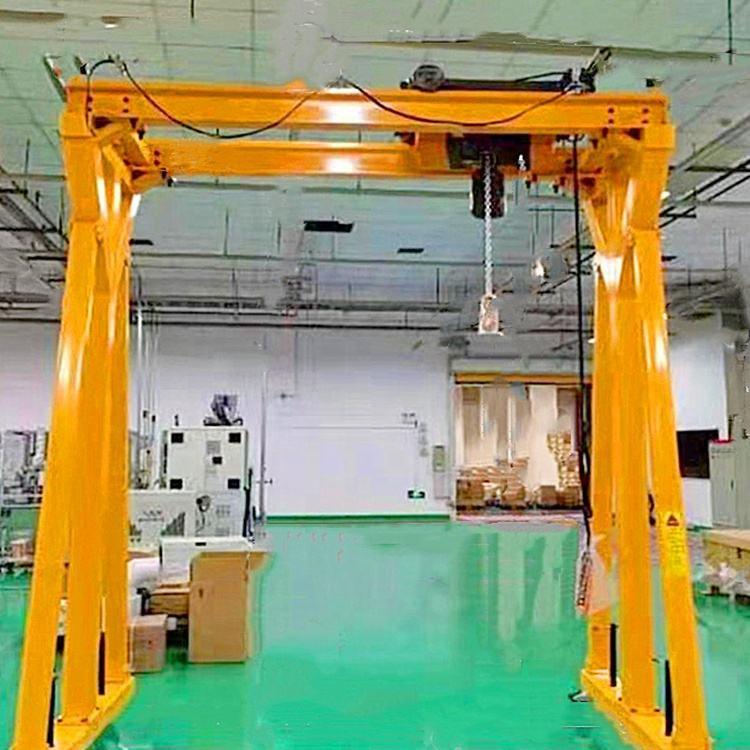
Travel path and supporting surface
Provide the yard layout, travel route, rail or floor arrangement and ground or foundation information. Confirm wheel loads and support requirements for the selected configuration.
Review the lifted load, working coverage and yard interfaces together with the selected rail-mounted, portable, semi-gantry or rubber-tyred arrangement.

Single-girder rail gantry at an outdoor yard
Listed rated capacity
Start with your known requirements. Our team can clarify the remaining interfaces.
Separate the listed product information from the dimensions and responsibilities that need your project input.
| Measured pickup and placement record | Mark actual load pickup, transfer and placement positions relative to a common datum and ground rails. Give local offsets and goods/attachment geometry in mm. Distinguish the required hook position from clearance for the load; ground-rail span alone does not establish usable coverage at every workpoint. |
|---|---|
| Complete loads and operating cycle | List goods and every suspended attachment in T for each task. Describe load frequency, movement distances, shifts and placement needs. Request the selected crane/hoisting ratings, duty and speeds for those tasks. Keep any future or occasional work separately identified instead of choosing a model from a title range. |
| Selected hoisting arrangement | Ask the offer to identify the actual hoist or winch/trolley arrangement, model, rating and supporting drawings. Reconcile that selection with the crane outline and site brief. Generic hoist/winch wording in a family listing does not choose the supplied lifting equipment or its dimensions. |
| Hook approaches and useful space | Provide required useful lifting travel in m and the load/attachment envelope and workpoint levels in mm. Request the selected hook extremes, approach dimensions, hoisting depth and relevant equipment outlines. Compare useful hook travel and usable load clearance separately from overall crane height. |
| Requested cantilever workpoints | If work outside the rail lines is needed, identify the side, required positions, complete task load and local obstacles. Ask for the proposed arrangement, selected coverage and stated conditions for that scope. A projecting beam in a reference image does not establish cantilever length, capacity or permission for the task. |
| Ground rails, services and site conditions | Send the measured rail/support survey, useful travel route, incoming voltage/frequency/phases and actual exposure requirements. Request selected reactions, power collection, outlines and site interfaces. Have the responsible site parties review these with local structures and access; the word portable does not establish castor mobility or an existing rail fit. |
| Coordinated outline and order scope | Compare the selected hoisting arrangement, workpoint response, drawings and open inputs under one revision. Agree hardware, rail/civil boundaries, proposed checks, instructions and requested support. List installation, training, spare parts and any cantilever option as explicitly included or separately quoted items. |
| Rated load | Complete suspended load including hoist, rigging and attachments. |
| Frame dimensions | Clear span, overall height, useful hook travel and adjustment range. |
| Wheels and movement | Caster or rail type, steering, brakes and loaded or unloaded movement rules. |
| Floor and access | Floor capacity, slopes, thresholds, doorway, turning and assembly clearances. |
| Hoist and storage | Selected hoist, power/control, transport dimensions and maintenance access. |
Listed information supports initial selection. Final dimensions, loads, speeds and components are defined in the project technical offer.
Provide the yard layout, travel route, rail or floor arrangement and ground or foundation information. Confirm wheel loads and support requirements for the selected configuration.
Show the required span, leg clearance, overhang if applicable, hook approaches and upper and lower hook positions. Identify vehicle routes and nearby structures.
Declare wind, temperature, corrosion and exposure where applicable. Confirm power delivery, travel restrictions and the operating cycle in the technical offer.
| Work package | Agree in the quotation |
|---|---|
| Gantry equipment | Selected bridge, legs, hoist or trolley, travel arrangement, controls and specified safety functions. |
| Travel support and utilities | Rails or suitable supporting surface, foundations where applicable, power feed and site interfaces. |
| Delivery and installation | Named delivery term, unloading, installation work, local labour and access equipment. |
| Acceptance and handover | Inspection and test plan, records, documentation, training, spare parts and warranty terms. |
This is a scope-planning checklist. Inclusion and responsibility depend on the agreed contract.
Review the lifted load, working coverage and yard interfaces together with the selected rail-mounted, portable, semi-gantry or rubber-tyred arrangement.
Use the Site interfaces tab above to check the layout and operating conditions. Record your requirements in the project brief alongside this page.
Review the product configuration and purchasing requirements for this equipment.
Portable Gantry Crane. Listed rated load: 5, 10 and 16 ton. A portable gantry crane uses a movable frame to support a hoist over a defined work area, with wheel type and travel conditions selected for the task. Also specified as a gantry crane, this equipment can be configured for the work area and lifting task. A portable frame can be positioned where local lifting is needed when its rated load, wheel path, floor and movement rules suit the work area. Common applications include equipment installation and maintenance and workshop assembly and repair. Select the configuration, working range, controls and supply scope for your operating conditions, then request a current, itemized quotation.
Confirm model, dimensions, duty, power supply, selected options, delivery and installation scope in the current technical offer.
START WITH THE LOAD
A portable gantry crane uses a movable frame to support a hoist over a defined work area, with wheel type and travel conditions selected for the task. A portable frame can be positioned where local lifting is needed when its rated load, wheel path, floor and movement rules suit the work area. Typical applications include equipment installation and maintenance, workshop assembly and repair, local lifting in buildings without a fixed runway. Compare the proposed configuration with the actual load, reach, duty and site dimensions.
Include lifting tackle in the load and state clear span, required hook travel and working frequency.
Specify adjustable height or span, caster or rail travel, loaded movement restrictions, locking and floor route.
Check floor loading, gradients, thresholds, doorways, headroom, assembly access and storage dimensions.
Saved supplier listing captured 2026-10-13; quantity tiers: 1-9 sets: US$6,500 per set · ≥10 sets: US$5,300 per set. The listing does not establish a current, project-specific or delivered price. Rated load, clear span, lift height and adjustable frame dimensions affect the frame design. Manual or powered travel, caster capacity, brakes and selected hoist change the package. Floor, indoor/outdoor exposure, assembly and movement requirements affect configuration. Transport, installation, accessories, quantity and delivery are confirmed in the quotation.
SEE THE EQUIPMENT
Review these portable gantry crane photographs alongside the requested operating conditions and layout. Visible equipment is a product-range reference; confirm the ordered configuration in the offer.
01 / PORTABLE GANTRY CRANE · 01Single-girder rail gantry at an outdoor yard. Include lifting tackle in the load and state clear span, required hook travel and working frequency.
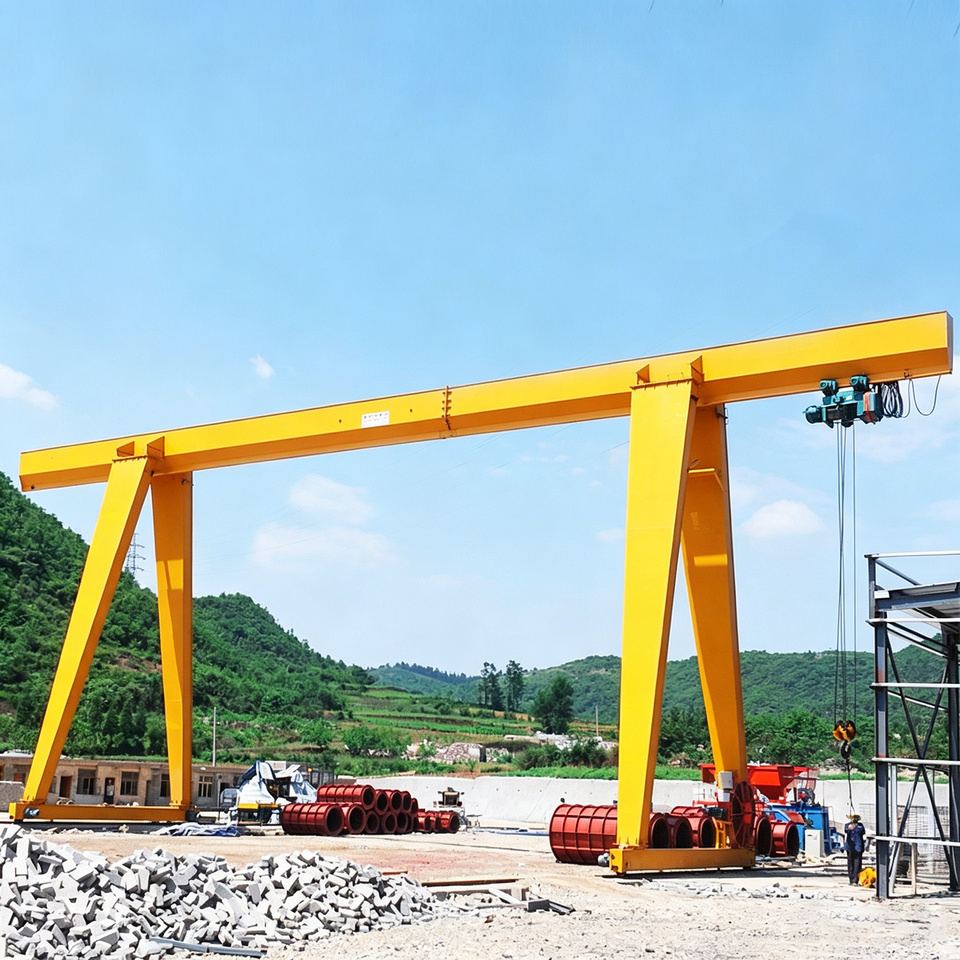 02 / PORTABLE GANTRY CRANE · 02
Single-girder rail gantry at an outdoor yard. Specify adjustable height or span, caster or rail travel, loaded movement restrictions, locking and floor route.
 03 / PORTABLE GANTRY CRANE · 03
Single-girder rail gantry at an outdoor yard. Check floor loading, gradients, thresholds, doorways, headroom, assembly access and storage dimensions.
State whether the frame must move unloaded or with a suspended load. Specify wheels, locks, floor route, operator position and hoist control for the selected use.
COMPARE THE COMPLETE PROPOSAL
Specify the equipment and services you need. Your quotation should identify what is included and what is priced separately.
Choose the equipment and services to include in the quotation. The final offer should state supplier and purchaser responsibilities for each site interface.
SITE DIMENSIONS · DUTY · EQUIPMENT SCOPE
Provide the layout and operating conditions to compare a portable gantry crane quotation against your actual project.
Discuss your siteHenan Mine Crane Group
Compare itemized quotations with the same equipment, delivery and site-service boundaries.
Confirm 5, 10 and 16 ton, selected mechanisms, control options and required accessories.
List rail or support work, power supply, clearances and purchaser-provided services.
State transport, unloading, erection, testing, commissioning and service parts included in the offer.
Historical supplier-listing information for context. Request a current quotation for your selected configuration and project scope.
Range combines the price tiers shown in the saved listing. Captured 2026-10-13. This is not a current project quotation; capacity, dimensions, options, quantity, delivery and included services affect final price.
Archived supplier-listing reference. The saved price is not a current quotation; confirm configuration, quantity, shipping and included scope. View saved source listing ↗
Bring engineering, purchasing and the installation team into the same scope before the purchase order.
Mark the travel path, working width, leg clearance, hook positions and load route. Include ground, rail or floor information and site access.
Send a drawing for reviewLoad or working task, layout, operating cycle, destination and timing.
Selected configuration, interface drawing, component schedule and scope exceptions.
Inspection, testing and documentation, delivery responsibilities and warranty terms.
A portable gantry crane uses a movable frame to support a hoist over a defined work area, with wheel type and travel conditions selected for the task.
Load, span and hook height: Include lifting tackle in the load and state clear span, required hook travel and working frequency. Frame and movement: Specify adjustable height or span, caster or rail travel, loaded movement restrictions, locking and floor route. Include the rated load, dimensions, operating cycle, site interfaces and required supply scope.
US$5,300–6,500 per set is the saved supplier-listing reference, captured 2026-10-13. Rated load, clear span, lift height and adjustable frame dimensions affect the frame design. Manual or powered travel, caster capacity, brakes and selected hoist change the package. Floor, indoor/outdoor exposure, assembly and movement requirements affect configuration. Transport, installation, accessories, quantity and delivery are confirmed in the quotation. Request a current quotation for the selected configuration, quantity, delivery and services.
Only when the selected model and operating instructions permit that condition. State the required movement and floor route for supplier confirmation.
Provide floor construction and allowable loading, route, gradients and thresholds. Check wheel loads and the specified travel condition.
 01
 02
 03
 04
 05
 06
 07
 08
EXPLORE OUR NEWSROOM
Projects, technology and updates
from Henan Mine Crane Group.
 01
Crane projects, dispatches and on-site applications.
 02
Equipment developments, engineering and manufacturing.
 03
Factory updates, partnerships and the people behind our cranes.
 04
Trade shows, industry meetings and company events.