Load and lifting-point drawing
Workpiece, centre of gravity, lifting points, beam/rigging weights and the proposed independent or shared lifting sequence.
Plan a 20+20 ton dual-hoist bridge crane around individual hook loads, permitted combined cases, hook spacing and the runway interface.

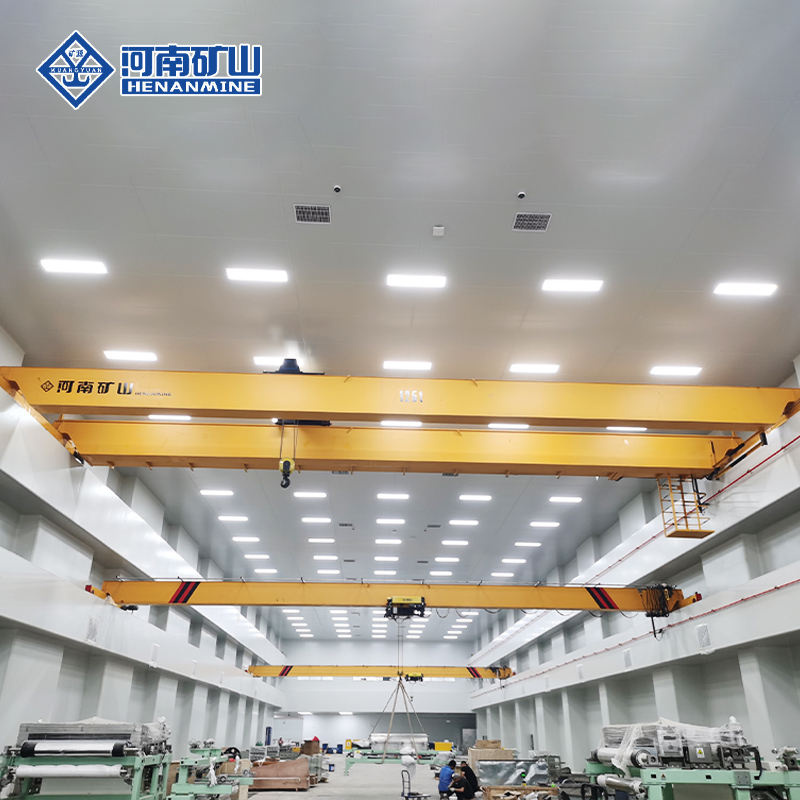
Red double-girder crane inside a workshop. Reference photograph; the view does not establish two 20 t hooks or permission for a combined lift.
Per-hoist enquiry class; confirm load cases
Start with your known requirements. Our team can clarify the remaining interfaces.
Separate the listed product information from the dimensions and responsibilities that need your project input.
| Hoist requirement | 20+20 t enquiry reference; specify the selected rated load of each hook and each lifting mechanism |
|---|---|
| Complete suspended load | Include the workpiece, lifting beam, slings and other suspended attachments in each load case |
| Load distribution | State lifting points, centre-of-gravity range and intended hook loading throughout pickup, travel and placement |
| Permitted combinations | Agree independent and any combined lifting cases; two 20 t references do not automatically authorize a 40 t lift |
| Trolley arrangement | Define one or separate trolleys, hook separation, relative travel and the permitted working envelope |
| Useful hook travel | Show upper and lower hook positions, rigging height, headroom and the alignment required at each workpoint |
| Bridge and runway coverage | Provide rail-centre span, travel distance, hook approaches and positions of columns, machines and services |
| Operating duty | Declare load spectrum, lifts per hour, starts, shifts and loaded travel; select crane and mechanism duties together |
| Control modes | Specify independent or coordinated operation, positioning needs, operator sight lines and motion speeds |
| Protection functions | Agree overload protection, upper/lower and travel limits, emergency stops and interlocks for the selected load cases |
| Runway actions | Obtain selected wheel reactions and horizontal forces for the agreed hook positions and operating/test cases |
| Power and installation | Confirm site supply, moving power feed, isolation, service access and rail, erection and commissioning responsibilities |
Listed information supports initial selection. Final dimensions, loads, speeds and components are defined in the project technical offer.
Workpiece, centre of gravity, lifting points, beam/rigging weights and the proposed independent or shared lifting sequence.
Hook separation and travel, upper/lower positions, headroom, rail-centre span, workpoints, columns and obstructions.
Selected wheel reactions and horizontal actions, support/rail responsibilities, site supply, moving power feed and service access.
| Work package | Agree in the quotation |
|---|---|
| Bridge and lifting equipment | Selected bridge, hoists, trolley arrangement and individual/combined rating schedule. |
| Control and protection package | Agreed operating modes, operator controls, limits, overload response and interlocks. |
| Site and installation work | Runway assessment, rails/fixings, power feed, delivery, unloading, erection and commissioning responsibilities. |
| Acceptance and handover | Agreed test cases and records, drawings, operating instructions, training, spare parts and warranty terms. |
This is a scope-planning checklist. Inclusion and responsibility depend on the agreed contract.
Define the lifting sequence, hook loads and working envelope before comparing the proposed dual-hoist arrangements.
Use the Site interfaces tab above to check the layout and operating conditions. Record your requirements in the project brief alongside this page.
Review the product configuration and purchasing requirements for this equipment.
A 20+20 ton dual-hoist enquiry needs a load-case drawing before a crane can be selected. State what each hook must carry, whether the hoists work independently or lift one load together, and how the load is shared through the lifting points and rigging. The selected bridge, trolley arrangement, controls and runway must be assessed for the permitted operating combinations.
MAP THE LIFTING SEQUENCE
Two hooks may serve separate workpoints or support one workpiece. Describe the intended sequence so the supplier can assess the structure, mechanisms and controls against the same operating cases.
Show lifting points, load dimensions and the expected centre-of-gravity range. Identify the lifting beam, slings and attachments, with their suspended weights. Include unequal hook loading in the proposed cases.
Mark the required hook spacing and relative motion. State whether each hoist must operate independently or maintain a coordinated position. Agree permitted movements, speeds and load restrictions before selecting a control mode.
Show landing positions, rigging clearance and the order in which each hook is unloaded. Include access for the operator and maintenance team, and any obstruction along the full load route.
REFERENCE PHOTOGRAPHS
The yellow examples below carry 20/5t markings. They illustrate bridge-crane layouts and do not prove the 20+20 t arrangement requested on this page. Use the selected drawing, rating schedule and technical offer to identify the supplied crane.
01 / REFERENCE PHOTOGRAPHRed double-girder crane inside a workshop. Reference photograph; the view does not establish two 20 t hooks or permission for a combined lift.
 02 / REFERENCE PHOTOGRAPH
Yellow bridge-crane examples marked 20/5t. Reference photograph; these markings do not identify a 20+20 t twin-hoist arrangement.
 03 / REFERENCE PHOTOGRAPH
A yellow 20/5t-marked bridge crane with blue machinery. Reference photograph; confirm the ordered hoist arrangement on its approved drawing.
CONTROLS AND PROTECTION
Define the operator position, controller and visibility of both lifting points. If coordinated lifting is required, agree the control method, permitted relative movement, overload response, limits and interlocks for that task. A radio controller or two hoists alone does not establish a synchronized lifting system.
Ask for a documented operating sequence and acceptance checks for each permitted mode, including stopping, restart and emergency-stop behavior. Any positioning tolerance or coordinated-motion performance must be stated for the selected equipment and load conditions.
BUILDING AND RUNWAY INPUTS
Provide the rail-centre span, travel length, support drawings and available headroom. Obtain the selected crane wheel reactions and horizontal actions for the agreed load combinations and hook positions. Allocate runway assessment, rail alignment and fixing design to named parties; a general family span or photograph is not a building design input.
Discuss your workshopHenan Mine Crane Group
Use the Supply scope tab to compare the bridge, hoists, trolley arrangement, controls, runway work, power feed and erection responsibilities. Include access for assembly, testing and future service.
Request the arrangement drawing, individual hook ratings, permitted load-case schedule, reaction data, control description and operating instructions. Agree inspection and testing for the selected modes and the records required at handover. Define delivery, commissioning, training, spare parts and warranty terms in the contract.
Historical supplier-listing information for context. Request a current quotation for your selected configuration and project scope.
Range combines the price tiers shown in the saved listing. Captured 2026-10-12. This is not a current project quotation; capacity, dimensions, options, quantity, delivery and included services affect final price.
Archived supplier-listing reference. The saved price is not a current quotation; confirm configuration, quantity, shipping and included scope. View saved source listing ↗
Bring engineering, purchasing and the installation team into the same scope before the purchase order.
Show the load and lifting points, centre-of-gravity range, hook spacing, rigging weights and independent/shared lifting sequence. Add hook limits, runway span and travel, headroom, support drawings and site power.
Send a drawing for reviewLoad or working task, layout, operating cycle, destination and timing.
Selected configuration, interface drawing, component schedule and scope exceptions.
Inspection, testing and documentation, delivery responsibilities and warranty terms.
Only the selected design and rating schedule can establish permitted combined lifts. Specify the complete suspended load, load at each hook, hook positions and operating sequence. Do not add two hoist references together as a capacity guarantee.
Describe both tasks when requesting the offer. The selected control system, protection functions and operating instructions must define which independent or coordinated movements are permitted and any load or position restrictions.
The workpiece centre of gravity, lifting-point spacing, rigging geometry and attachment weights affect load distribution. Provide these inputs and any changes during the lifting sequence so unequal hook loading can be assessed.
These are reference photographs from the corresponding product archive. A 20/5t-marked example does not demonstrate a 20+20 t twin-hoist configuration. Identify the ordered equipment through its selected drawing and rating schedule.
The supplier listing captured 2026-10-12 shows US$6,300 per set for 1–2 sets and US$5,760 for at least 3. These historical tiers do not define a current dual-hoist quotation or delivered price. Request an itemized offer for the selected load cases, dimensions, controls, quantity and services.
 01
 02
 03
 04
 05
 06
 07
 08
EXPLORE OUR NEWSROOM
Projects, technology and updates
from Henan Mine Crane Group.
 01
Crane projects, dispatches and on-site applications.
 02
Equipment developments, engineering and manufacturing.
 03
Factory updates, partnerships and the people behind our cranes.
 04
Trade shows, industry meetings and company events.