
Water conservancy / Underground pump station
125t Bridge Cranes for Underground Pump-Station Lifting
Henan Mine Crane Group manufactured several bridge cranes, including equipment rated at 125t, for lifting equipment in an underground pump station at an unnamed national water-conservancy project. The configuration combines coordinated lifting points with controlled low-speed hoisting and detailed operating diagnostics.
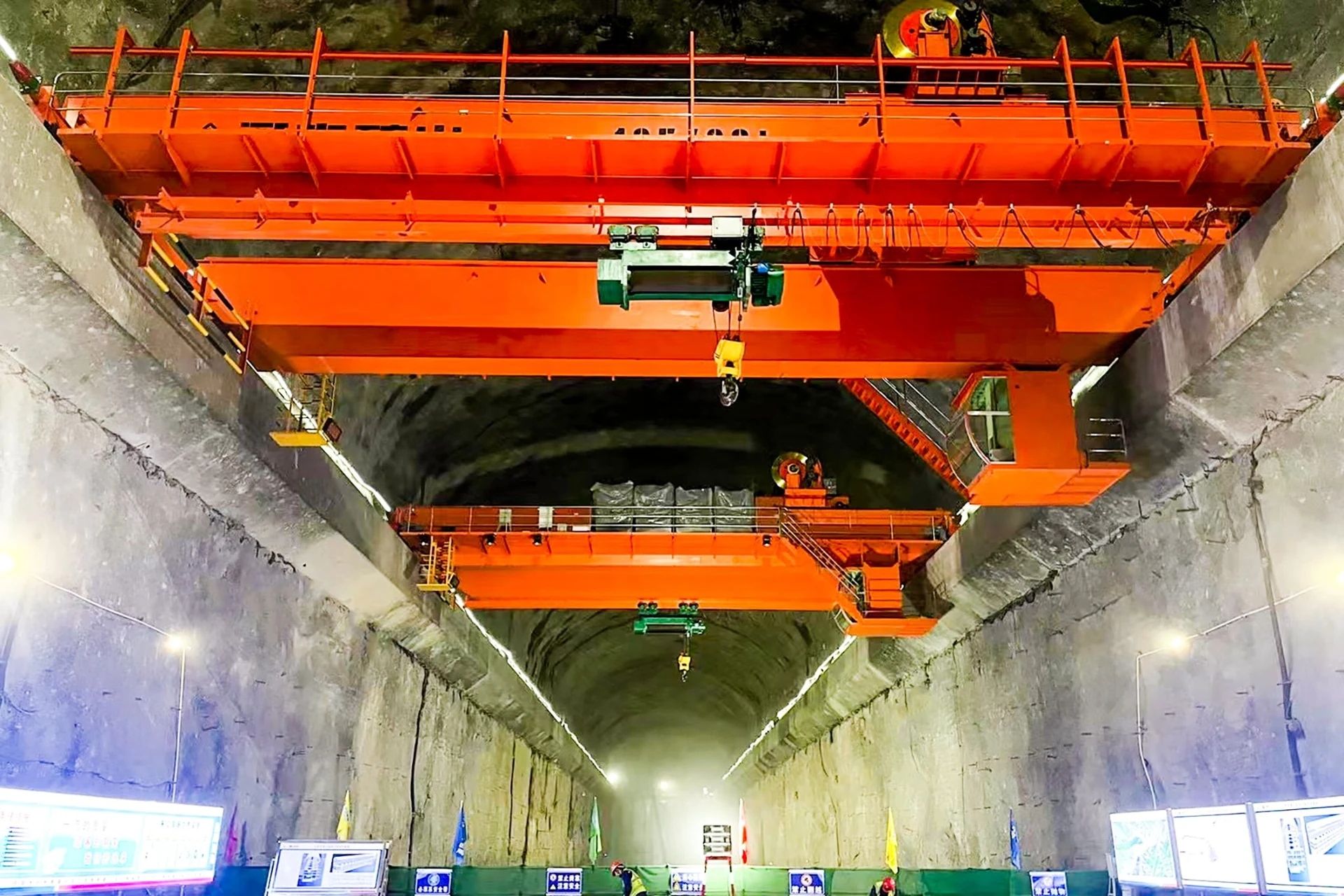
- Application
- Underground pump-station unit lifting
- Equipment
- Several bridge cranes, including equipment rated at 125t
- Project
- Unnamed national key water-conservancy project
- Electrical control
- PLC and VFD communication control
- Hoisting
- Four-quadrant operation and synchronized lifting points
- Diagnostics
- Coordinates, operating/protection/fault signals, alarms and records
Underground pump-station units define the lift
The cranes serve underground pump-station unit lifting at a national water-conservancy project. The 125t rating identifies equipment within a wider supply of bridge-crane types. For a comparable installation, match each crane to the unit it handles, the available station space and the required lifting route.
For a comparable purchase, identify the complete pump-station unit and its lifting arrangement. Include attached equipment and rigging in the gross load. Underground access, runway geometry and the route to the installation position need to be considered together so the required hook positions are achievable.
Coordinated motion and load balance
PLC and variable-frequency drives communicate across the crane control system. Multiple lifting points are synchronized with automatic balancing. This supports an underground pump-station unit in a controlled orientation while it is raised or moved toward its installation position.
Define the number and spacing of lifting points, the expected load distribution and the permitted difference in movement. Set acceptance criteria from the component and installation procedure. Include any changes in support conditions during pickup, travel and final approach.
Four-quadrant hoisting for controlled low-speed work
The hoisting mechanism operates in four quadrants, with speed regulation, high starting torque and substantial torque at low speed. Those characteristics are relevant when heavy station equipment must approach a seat or alignment position under control.
Request the proposed speed range and explain each critical stage of the lift. Include pickup from supports, raising through restricted sections, final approach and lowering. Agree the operating parameters and the conditions under which they will be demonstrated with the actual lifting arrangement.
Diagnostics that support acceptance and operation
The integrated detection system displays three-dimensional coordinates, operating signals, protection signals and fault information. Diagnostic, alarm, recording, printing and communication functions are reported. These functions can help operators and maintenance personnel understand what condition interrupted a movement.
Specify the display language, event information and records required at handover, and identify any plant system that must receive signals. Agree factory checks and installed functional tests around the pump-station lift. The project also received CCTV news coverage; the purchasing focus remains the equipment functions and their acceptance.
Application photographs
See the equipment and working context.
Photographs and accompanying illustrations from this application report. Open an image for a larger view.


Application reference: Henan Mine Crane Group official application report. Equipment and operating advice for a new project should be specified against your load, process and site.
Start the equipment discussion
Relevant equipment families.
Compare the equipment family with your operating duty. Final attachments, controls and protection follow the application requirements.
Double-girder overhead cranes
Assess station runway geometry and the required coordinated lifting arrangement.
View equipment options ↗Winch-trolley overhead cranes
Evaluate winch-trolley hoisting around the gross load, low-speed duty and multi-point control requirements.
View equipment options ↗Plan a similar application
Build the specification
around your operation.
Provide the underground station sections and unit-lifting procedure for a coordinated assessment of load, access and controls.
- Pump-station unit drawings, total lifted mass and rigging details
- Lifting-point locations, load distribution and permitted unit tilt
- Underground layout, runway level, access openings and hook elevations
- Pickup, travel, installation and future removal procedures
- Required low-speed control, synchronization and acceptance tolerances
- Diagnostic displays, printed records, plant communications and test scope
Before you specify
Questions for
your project.
What information is needed for an underground station lift?
Provide the unit drawing, lifting points, station sections and the route through access openings. Include the attachment, rigging and final installation position.
How can diagnostics support the lifting operation?
Coordinates and operating, protection and fault signals help operators understand equipment status. Specify the alarms, event records and plant communications your operating team needs.
How should multi-point movement be accepted?
Agree the load distribution, allowed movement difference and representative lift sequence. Use the actual component interface or an agreed test arrangement to demonstrate the requirement.
Continue exploring
More water conservancy & power applications.

Automated Crane Handling for Power-Cable Warehouses
Two custom automated cranes move box-substation power-cable materials between warehouse and workshop operations. Load recognition, controlled pickup and dispatch records form one handling sequence.
Explore this application
600t Low-Headroom Bridge Crane for Pumped-Storage Construction
The 600t bridge crane forms part of a wider equipment package for an unnamed pumped-storage station. Its configuration combines low headroom and synchronized hooks, with factory preassembly supporting the project quality plan.
Explore this application
Crane Package for Offshore-Wind Final Assembly
Dozens of crane units support heavy-workpiece handling at an unnamed offshore-wind turbine final-assembly base. Coordinated hooks and high-lift hoisting are the specific configuration focus.
Explore this application


