
Steelworks / Overseas application
100+ Crane Package for a Southeast Asian Steelworks
More than 100 crane units or sets serve a large steelworks in Southeast Asia. Henan Mine Crane Group supplied a mixed package including 160t double-girder overhead cranes, slab-tong cranes, under-rotating electromagnetic lifting-beam cranes and twin-trolley gantries for the project's port scrap yard.

- Location
- Southeast Asia; customer name not disclosed
- Supply scope
- More than 100 mixed units or sets
- Named overhead rating
- 160t double-girder overhead cranes
- Load-specific equipment
- Slab tongs and under-rotating electromagnetic lifting beams
- Yard equipment
- Double-main-girder, twin-trolley gantry cranes
- Reported stage
- Equipment in application at the steelworks
Coordinate several steelworks handling processes
The package covers production lifting, material transfer and scrap loading or unloading at an unnamed Southeast Asian steelworks. Its more-than-100-unit scope brings together crane types with different load interfaces. The 160t overhead rating identifies one type within the mixed package, rather than the capacity of every crane.
This is a useful approach for a plant with several handling areas. A production bay, a slab route and a port scrap yard can share purchasing or maintenance requirements while still needing their own crane layouts and attachments. The equipment schedule should preserve those differences from the beginning.
Separate production lifting from slab gripping
Double-girder overhead cranes rated at 160t form part of the supply. Slab-tong cranes provide a separate handling arrangement for slab loads. Keeping those duties distinct makes it possible to match the attachment and crane to the load rather than selecting every unit from one headline capacity.
For a slab enquiry, provide the minimum and maximum dimensions, gross mass, temperature and permitted contact faces. The gripping arrangement and hook coverage can then be assessed against the transfer route. For other production loads, identify lifting points and attachment weights so that capacity comparisons use the same suspended-load basis.
Use rotating magnetic beams where the steel load fits
Under-rotating electromagnetic lifting-beam cranes are another part of the steelworks package. The arrangement supports a different way of holding and orienting steel stock from a mechanical slab tong. Its selection begins with compatibility between the magnet system and the actual ferrous load.
Submit steel geometry, surface condition, thickness and temperature together with the required handover orientation. The turn also needs room: show surrounding structures and the load envelope along the route. Define the load-retention requirements with the supplier so that the attachment, crane and operating procedure are assessed together.
Plan twin-trolley gantries around the scrap yard
Double-main-girder, twin-trolley gantry cranes are used in batches in the project's port scrap yard. They form the outdoor part of a package that also serves indoor production and stock movement. The gantry arrangement should therefore be reviewed against the yard's own travel and loading geometry.
For your yard, identify the scrap forms, stock areas, vehicle or other handover interfaces and discharge positions. Include the working-area drawing and environmental conditions. If a lift needs coordinated trolley motion or a specific scrap attachment, define that requirement explicitly so that it becomes part of the proposed configuration and acceptance plan.
Create a duty-by-duty supply schedule
List each bay or yard with its load family, required movements and handover points. That allows common controls, spare-parts or maintenance requirements to be coordinated across the package while retaining the specific needs of slab gripping, magnetic transfer and outdoor scrap handling.
Set priorities for each duty: production access, load orientation, yard coverage or movement frequency. A coordinated proposal can then show the selected equipment and interfaces for each location. This is more useful than treating a large unit count as the technical specification for a complete steelworks.
Procurement review
Prepare a steelworks package for technical approval
A mixed package needs a common document register and a separate equipment line for each handling duty. For a supply like this steelworks reference, connect production-bay cranes, slab attachments, rotating magnetic beams and scrap-yard gantries to their own load cases and interfaces.
Swipe across the table to view all columns.
| Review item | Include in your procurement pack | Decision it supports |
|---|---|---|
| Equipment schedule | Bay or yard ID, quantity, gross suspended load, selected crane rating, travel coverage and working cycle for each line. | Compare offers on the same set of duties and keep attachment mass in the load basis. |
| Attachment schedule | For tongs: slab geometry, temperature and gripping faces. For magnets: steel geometry, material, surface, temperature and the load-retention arrangement. | Review each load interface and its operating restrictions before equipment selection. |
| Common interfaces | Runway drawings, electrical supply, command locations, interlocks, maintenance access and the allocation of site work. | Separate plant responsibilities from the crane and attachment supply. |
| Handover register | Agreed drawings, inspection and test plan, unit identification, manuals, spare-parts information and item-specific acceptance records. | Trace the equipment schedule through factory completion, installation and handover. |
Assign an owner and revision to each document. List required records in the quotation so the comparison includes documentation, witnesses and site work as well as equipment.
Application photographs
See the equipment and working context.
Photographs and accompanying illustrations from this application report. Open an image for a larger view.


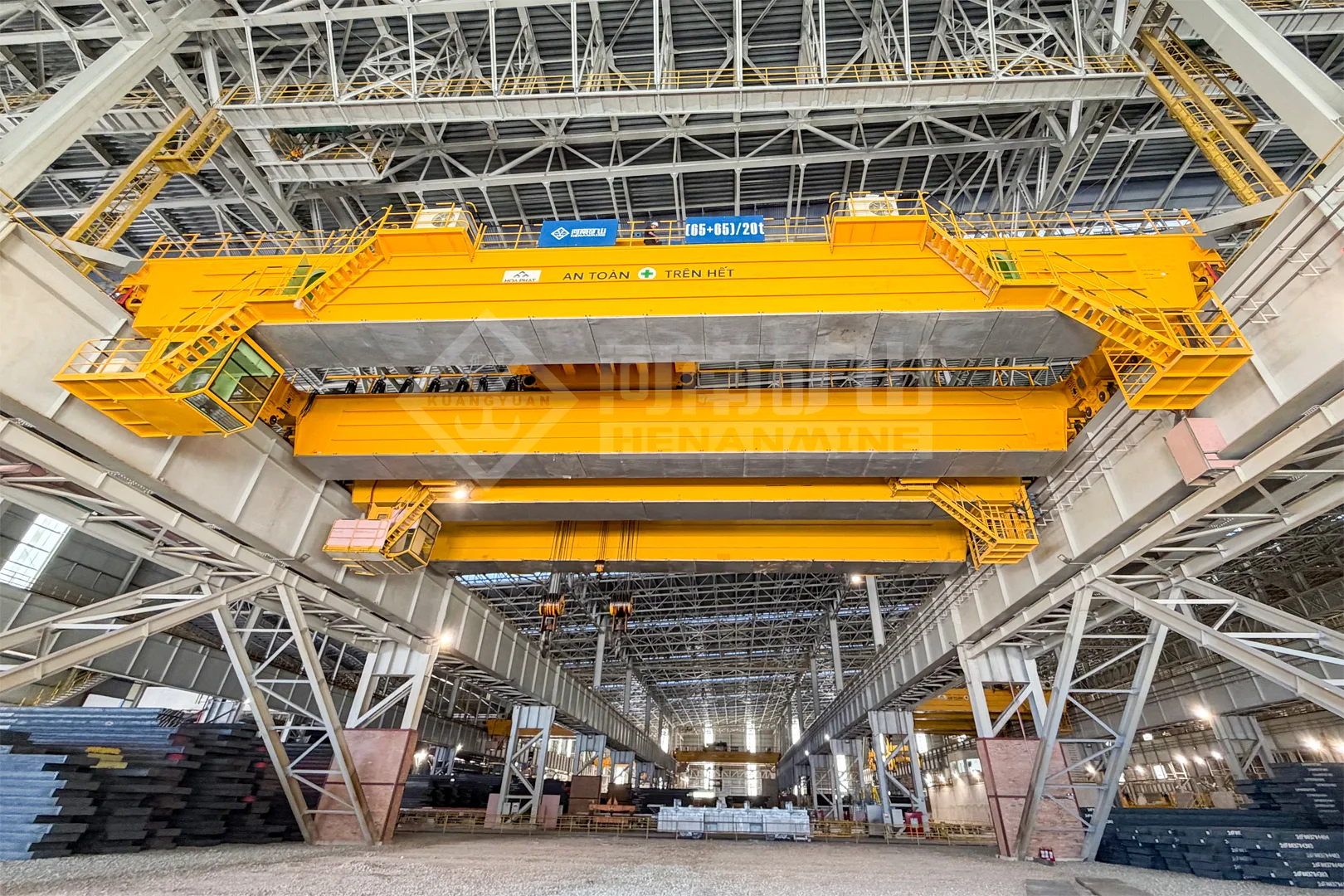


Application reference: Henan Mine Crane Group official application report. Equipment and operating advice for a new project should be specified against your load, process and site.
Start the equipment discussion
Relevant equipment families.
Compare the equipment family with your operating duty. Final attachments, controls and protection follow the application requirements.
Double-girder overhead cranes
Assess for the defined production-bay loads and runway geometry; the 160t example is project-specific.
View equipment options ↗Rotating magnetic lifting-beam cranes
Consider only for compatible ferrous loads with an engineered attachment and load-retention strategy.
View equipment options ↗Double-girder gantry cranes
Evaluate for the scrap-yard layout and attachment duty; twin-trolley details require a project-specific proposal.
View equipment options ↗Plan a similar application
Build the specification
around your operation.
For a multi-crane steelworks package, send a duty schedule covering:
- Crane quantities by bay or yard, with a load and attachment list for each duty.
- Maximum gross lifting loads, lifting points and required auxiliary motions.
- Slab size and temperature ranges, plus gripping and contact restrictions.
- Steel-stock data and orientation requirements for any proposed magnetic handling.
- Runway and yard drawings, spans, rail levels and loading or discharge positions.
- Operating cycles, outdoor conditions and required controls, monitoring and maintenance interfaces.
Before you specify
Questions for
your project.
How should I organise an enquiry for several steelworks cranes?
Use one equipment schedule with a separate row for each bay or duty. Include quantities, gross loads, attachments, route drawings, operating cycles and common plant requirements.
Can slab tongs and magnetic beams use the same load data?
Both need dimensions and mass, but their interfaces differ. Tongs need gripping/contact information; magnetic handling also needs suitable ferrous material, surface and retention data.
What information helps select a scrap-yard gantry?
Send the yard layout, material forms, loading and discharge positions, required coverage and operating conditions. Identify any need for coordinated trolley movement or a particular attachment.
Continue exploring
More steel & metallurgy applications.

Automated Feeding Cranes for an Ulanqab Ferrochrome Project
Several automated metallurgical cranes were developed for a ferrochrome project in Ulanqab, Inner Mongolia. Remote centralized control coordinates hooking, unhooking and material feeding.
Explore this application
Two Automated Coke-Pot Cranes for a Coking Process
Two automated coke-pot cranes were developed for an unnamed domestic coking customer. The configuration combines variable-frequency motion, remote video and mechanical anti-sway.
Explore this application
450t Four-Girder Foundry Crane for Molten-Metal Handling
450t four-girder, four-rail foundry equipment was customised for an unnamed steelmaking customer. The documented design combines whole-frame machining, PLC control and lifecycle safety records.
Explore this application


