
Offshore wind / Heavy equipment handling
500t Twin-Trolley Crane for Offshore-Wind Equipment
Henan Mine Crane Group’s 500t new-type double-girder crane with twin trolleys completed installation and entered operation at an unnamed offshore-wind project. The company manufactured 43 crane units for phase one, with the featured 500t configuration forming part of that broader package.

- Featured rating
- 500t
- Arrangement
- New-type double-girder crane with twin trolleys
- Phase-one package
- 43 crane units/sets in total
- Reported stage
- Featured crane installed and operating
- Motion features
- High lift, automatic fast/slow selection and synchronized hooks
- Observation
- Electrical anti-sway, digital/video monitoring and lifecycle management
One heavy-lift configuration within a larger package
Offshore-wind equipment involves heavy workpieces moving between preparation and assembly positions. The installed 500t twin-trolley crane supports those movements within a wider phase-one equipment package. For a new facility, prepare a load and station schedule linking each crane to the component and route it must serve.
The distinction matters when planning a factory package. Forty-three units is the total phase-one supply, not forty-three identical 500t cranes. Build a new equipment schedule from the work performed in each bay, including auxiliary handling duties and interfaces with production fixtures.
Twin trolleys and synchronized lifting points
The featured design combines two trolleys with high-precision synchronization of multiple hooks. Electrical anti-sway is provided across the crane. These functions support controlled handling of heavy workpieces, particularly where the load must remain in a defined orientation between lifting points.
Establish whether the hooks will work independently, together or in different combinations. Provide lifting-point spacing, centre of gravity, permissible load distribution and expected changes during assembly. Agree synchronization and load-sharing criteria for each permitted operating mode.
Hoisting range and observation of the work area
The lightweight hoisting design provides high lift and automatically selects fast or slow movement. Define the main travel and final-approach stages around the workpiece and assembly position. Evaluate the proposed speeds and operating cycle against the actual workshop duty.
Digital and image-based monitoring provide protection and support lifecycle management. Identify which parts of the load route operators must see, the required camera coverage and what information should be recorded. The proposed arrangement should be checked against the actual plant layout and assembly procedure.
Use the operating milestone to plan project acceptance
The featured 500t crane completed installation and entered operation. For your project, define factory, installation and operational checks as explicit contractual stages. Link the final functional demonstration to the actual load arrangement and the intended work positions.
Henan Mine Crane Group had also developed a 400t crane for a separate nuclear-power project. For the wind-equipment purchase, keep each duty, load rating and acceptance record associated with the equipment being supplied. Identify any additional area or industry requirements directly in the specification.
Application photographs
See the equipment and working context.
Photographs and accompanying illustrations from this application report. Open an image for a larger view.
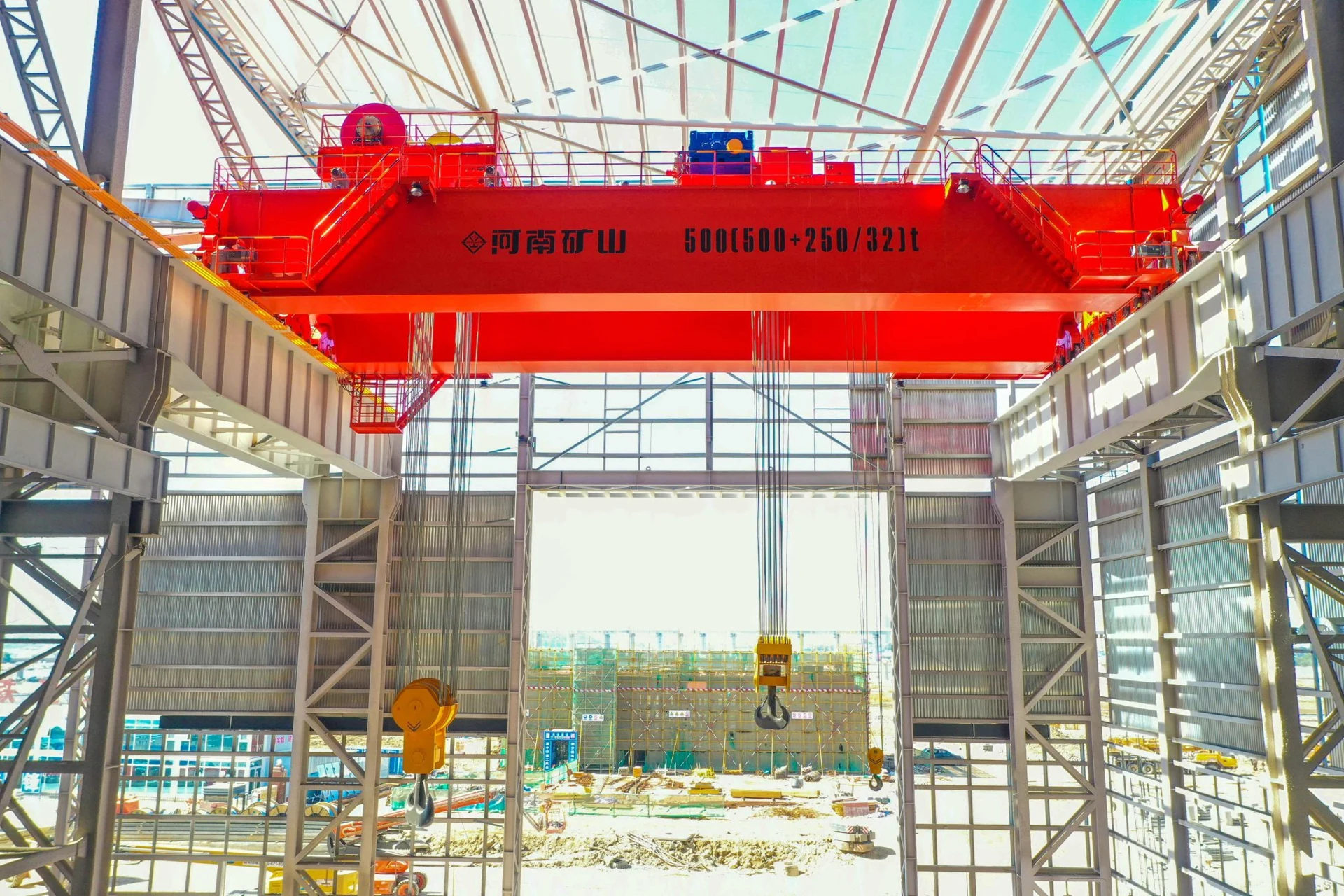
Application reference: Henan Mine Crane Group official application report. Equipment and operating advice for a new project should be specified against your load, process and site.
Start the equipment discussion
Relevant equipment families.
Compare the equipment family with your operating duty. Final attachments, controls and protection follow the application requirements.
Double-girder overhead cranes
Compare bridge arrangements for the complete wind-equipment handling route.
View equipment options ↗Winch-trolley overhead cranes
Discuss high-lift winch-trolley and coordinated-hook configurations around the actual duty.
View equipment options ↗Plan a similar application
Build the specification
around your operation.
Send your wind-equipment load schedule and twin-trolley operating concept to discuss an appropriate heavy-lift configuration.
- Heaviest complete workpiece, rigging mass, dimensions and centre of gravity
- Required hook combinations, lifting-point spacing and load distribution
- Factory bay sections, runway span, hook travel and assembly clearances
- Independent and coordinated movements with required approach speeds
- Anti-sway, camera coverage, event records and operating access controls
- Equipment schedule, factory tests, installation and site acceptance milestones
Before you specify
Questions for
your project.
How can twin trolleys support the workpiece?
Define the lifting points and required operating combinations. The design review should check load distribution, permitted orientation and the movement sequence for each combination.
How should a multi-crane factory package be scheduled?
List equipment by bay, duty and required availability. The 43-unit phase-one package illustrates why the featured heavy-lift crane should be distinguished from supporting duties.
What should be included in site acceptance?
Check the installed interfaces and agreed operating functions, including coordinated hooks, travel and monitoring. Use representative load and route conditions with defined acceptance records.
Continue exploring
More water conservancy & power applications.

Automated Crane Handling for Power-Cable Warehouses
Two custom automated cranes move box-substation power-cable materials between warehouse and workshop operations. Load recognition, controlled pickup and dispatch records form one handling sequence.
Explore this application
600t Low-Headroom Bridge Crane for Pumped-Storage Construction
The 600t bridge crane forms part of a wider equipment package for an unnamed pumped-storage station. Its configuration combines low headroom and synchronized hooks, with factory preassembly supporting the project quality plan.
Explore this application
Crane Package for Offshore-Wind Final Assembly
Dozens of crane units support heavy-workpiece handling at an unnamed offshore-wind turbine final-assembly base. Coordinated hooks and high-lift hoisting are the specific configuration focus.
Explore this application


